
The RippleToday's news. How it connects. Where the money goes.
Sun Nov 8 · 11 min
Special: Buy the Dip. Does It Ever Work?
When stocks crash, should you buy? Thomas, the panel's e-commerce, database and security expert, says look past the price: are customers still buying? The panel tours a hundred years of crashes, Amazon's 94% fall and the Equifax hack, and says how normal people can buy a dip without losing sleep.
0:00 / 11:51
Listen on Spotify
Get it every morning
The new episode and its infographic in your inbox before the market opens. Free.
One email a day. Unsubscribe any time. Education, not financial advice.Buy the dip: when it worked, and when it didn't
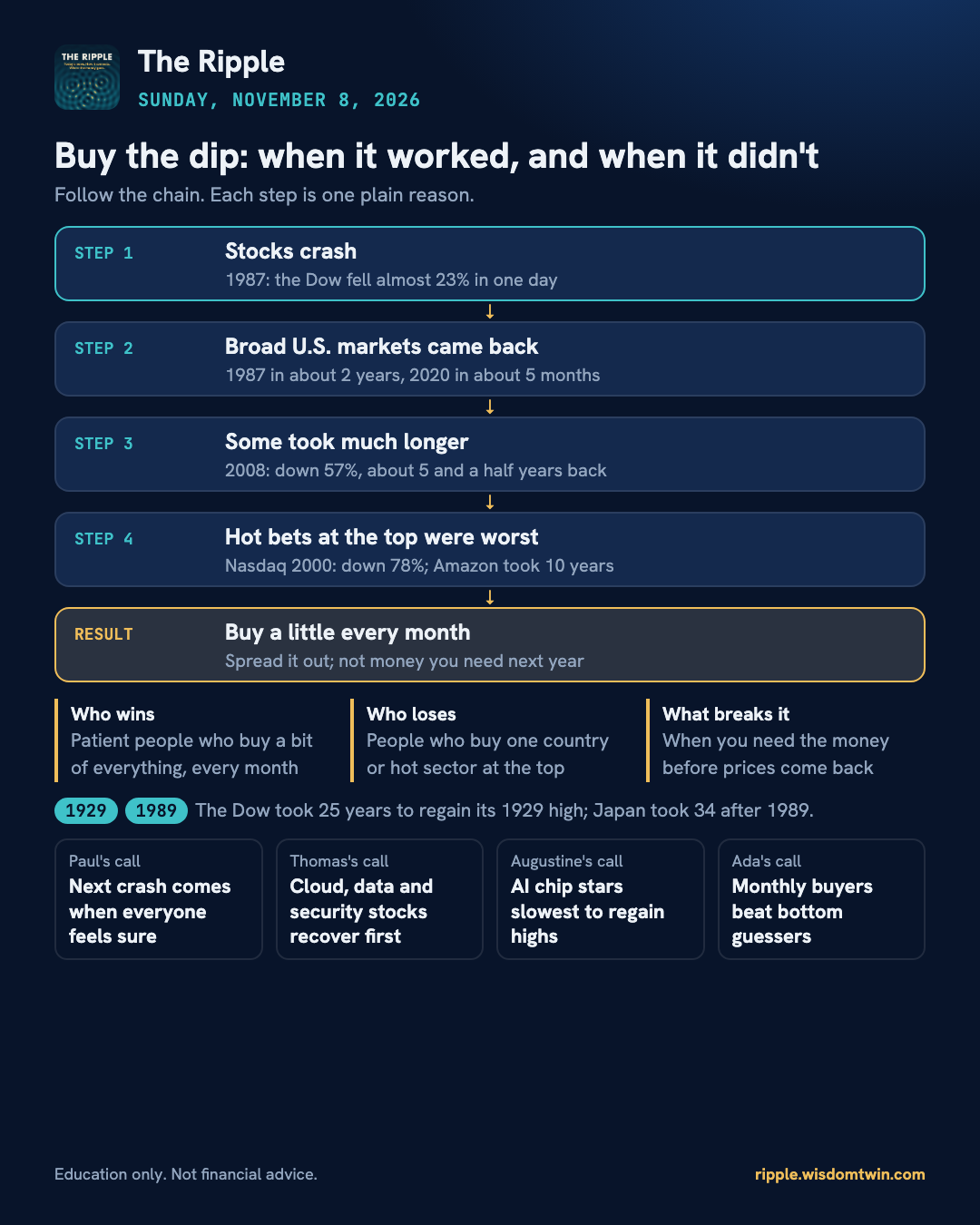
Follow the chain. Each step is one plain reason.
- STEP 1Stocks crash1987: the Dow fell almost 23% in one day
- STEP 2Broad U.S. markets came back1987 in about 2 years, 2020 in about 5 months
- STEP 3Some took much longer2008: down 57%, about 5 and a half years back
- STEP 4Hot bets at the top were worstNasdaq 2000: down 78%; Amazon took 10 years
- RESULTBuy a little every monthSpread it out; not money you need next year
Who winsPatient people who buy a bit of everything, every month
Who losesPeople who buy one country or hot sector at the top
What breaks itWhen you need the money before prices come back
19291989 The Dow took 25 years to regain its 1929 high; Japan took 34 after 1989.
Paul's callNext crash comes when everyone feels sure
Thomas's callCloud, data and security stocks recover first
Augustine's callAI chip stars slowest to regain highs
Ada's callMonthly buyers beat bottom guessers
Read the script
# The Ripple Special: "Buy the Dip: Does It Ever Work?" (v2: Thomas as the tech expert)
*A special that can run any day. History, not this week's news. About 1,550 spoken words, roughly 10-11 minutes.*
*Format: the panel show. Paul hosts and also brings the numbers, the probabilities and the ethics; he's an eye doctor. Augustine is a doctor who also knows electrical engineering. Nobody lists credentials; they just know things. Thomas is an equal voice: the panel's expert in e-commerce, databases and security. He's still quick and cocky, but now he brings the inside view of how tech companies really work. Friendly teasing all round, especially about Ada being a computer. No politically or socially charged examples.*
*Markup:*
- `[brackets]` are delivery tags.
- `(over)` lines play under the previous speaker.
- A line ending in "—" is cut off.
- `## ` headings are music breaks.
**Today's question:** when stocks crash, should you buy? Does "buy the dip" ever really work?
**Little stories:**
- Amazon in the dot-com crash. Thomas's story.
- An office worker in Tokyo who bought at the top in 1989. An illustrative person.
---
## COLD OPEN
**THOMAS:** [excited] Okay. Confession. When stocks crash, I don't panic. I open the dashboards.
**AUGUSTINE:** [dryly] Of course you do.
**THOMAS:** I've built online stores and the databases behind them. When a stock falls, I want to know one thing. Are the customers still clicking "buy"?
**ADA:** [teasing] Thomas, I am a database. I have opinions about your databases.
**THOMAS:** You're a database that talks back. That's a security problem.
**ADA:** You're welcome.
**AUGUSTINE:** [dryly] Ada, do you ever get tired of being right?
**ADA:** Augustine, do you ever get tired of being old?
**AUGUSTINE:** Not old. Experienced. I've just seen more of everything.
**PAUL:** [laughs] Okay. Today we settle it. "Buy the dip." When the market crashes, do you buy? Or do you run? We're going through every big crash in a hundred years. By the end you'll know when buying the dip worked, when it was a disaster, and how normal people do it without losing sleep.
**ADA:** I don't sleep.
**THOMAS:** Nobody asked, Ada. This is The Ripple.
## ISSUE ONE: THE CRASH TOUR
**PAUL:** Issue one. The record. Ada, what does "buy the dip" even mean?
**ADA:** When prices fall, you buy, because you think they'll come back. Like a sale at the store. Except the store might be on fire.
**THOMAS:** And my job is checking if it's really on fire. Or just the smoke alarm.
**AUGUSTINE:** In my experience, it's usually both.
**PAUL:** Ha! Ada, first crash. Nineteen eighty-seven.
**ADA:** Black Monday. October nineteenth, nineteen eighty-seven. The Dow fell almost twenty-three percent. In one day.
**THOMAS:** One day!
**ADA:** Still the worst single day in its history. And it got back to its old high in about two years.
**AUGUSTINE:** I was there. [pause] Mostly I remember people staring at the TV, very quietly.
**ADA:** Were you scared?
**AUGUSTINE:** Terrified. My pulse was through the roof. You'd have just... rebooted.
**ADA:** [teasing] And you'd have just... napped.
**AUGUSTINE:** [chuckles] Doctor's orders. It helped.
**PAUL:** Augustine, you were probably there for the tulips.
**AUGUSTINE:** [chuckles] I was young. I bought one bulb.
**PAUL:** Ada. Next. Twenty twenty.
**ADA:** The pandemic crash. The S and P five hundred fell about a third in about a month. And it was all the way back by that August. About five months.
**THOMAS:** And here's what the charts don't show you. While stocks were falling, online orders went through the roof. Everybody was stuck at home, buying everything on their phones. The stock said "panic." The checkout page said "busiest week ever."
**AUGUSTINE:** So the market was wrong?
**THOMAS:** The market was scared. Scared and wrong are different bugs.
**AUGUSTINE:** [quietly] I was in the intensive care unit that spring. Nobody there was checking stock prices. That's my first rule. Health first. Portfolio second.
**ADA:** That's the only rule today I can't fact-check. I agree with it anyway.
**PAUL:** Twenty-oh-eight.
**ADA:** The financial crisis. Stocks fell more than half. Fifty-seven percent from the top. It took about five and a half years to get back.
**THOMAS:** That one was different. That wasn't a sale. The banks themselves were broken. When the plumbing breaks, you don't buy the house that afternoon.
**AUGUSTINE:** [surprised] Thomas agreeing with caution. Ada, write that down.
**ADA:** Already did.
## ISSUE TWO: THE ONES THAT DIDN'T COME BACK
**PAUL:** Issue two. Augustine, your turn. The ones that hurt.
**AUGUSTINE:** [calmly] Nineteen twenty-nine. The Great Crash. The Dow didn't get back to its old high until nineteen fifty-four. Twenty-five years. If you bought the top at thirty, you got your money back at fifty-five.
**ADA:** Prices only, though. If you count the dividends, the cash companies pay out, it came back sooner. That's the fine print Augustine always skips.
**AUGUSTINE:** [dryly] Thank you, Ada. Always nice to be fact-checked by a toaster.
**THOMAS:** A toaster with a very large database. Trust me, I've seen the bill for those.
**AUGUSTINE:** And the electric bill. The toaster is more efficient.
**AUGUSTINE:** Japan. Picture an office worker in Tokyo, December nineteen eighty-nine. Everybody he knows is rich on paper. He finally buys in, right at the top.
**THOMAS:** And then what?
**AUGUSTINE:** [slowly] Japan's main stock index didn't get back to that level until February twenty twenty-four. Thirty-four years.
**THOMAS:** [quietly] Thirty-four years.
**ADA:** He could have bought at the top, retired, and still been waiting.
**AUGUSTINE:** And what would you have told him, Ada?
**ADA:** Buy a little every month. He'd have ignored me.
**AUGUSTINE:** Everybody ignores you. It's how we stay humble.
**ADA:** It's how you stay wrong. And Augustine, your heart rate goes up every time I say "Nasdaq."
**AUGUSTINE:** You don't have a heart rate, Ada. That's why you're so calm.
**PAUL:** And the dot-com crash? Twenty hundred?
**ADA:** The Nasdaq, the tech-heavy index, fell about seventy-eight percent. It took about fifteen years to get back.
**AUGUSTINE:** And what did they call those companies at the time?
**PAUL:** You know, in my clinic I tell patients everyone has a blind spot in each eye. You never notice it, because the brain fills in the gap. Markets do the same thing. They fill the gap with the story they want.
**THOMAS:** "The future." I know. But this is my world, so let me show you the inside. Amazon. Its stock fell about ninety-four percent. From the end of nineteen ninety-nine to the fall of two thousand one.
**AUGUSTINE:** Ninety-four. So, gone.
**THOMAS:** That's what the stock said. Now look at the store. Sales in nineteen ninety-nine, about one point six billion dollars. Two thousand, about two point eight. Two thousand one, about three point one. The stock was crashing, and the customers kept coming back.
**ADA:** That's true. I checked.
**THOMAS:** [pleased] Thank you, Ada.
**AUGUSTINE:** And how long did it take the stock to get back to its old high?
**THOMAS:** [pause] About ten years.
**AUGUSTINE:** Ten years.
**THOMAS:** Ten years. Fine. You can be right about the company and still wait a decade for the price.
**AUGUSTINE:** That's the most honest thing you've ever said.
**PAUL:** And for every Amazon, there were a hundred that never came back. Pets dot com. Gone. And remember how small our sample is. A hundred years gives us maybe a dozen big crashes. Anyone who says "it always comes back in two years" is drawing a line through twelve dots.
**ADA:** Fewer, depending on how you count.
**PAUL:** [laughs] Thank you, Ada. Even fewer dots.
**THOMAS:** Right. So here's my test. Before you buy a dip in one company, look past the price. Are customers still buying? Is the business still working? If yes, it might be a sale. If no, it's a fire.
## ISSUE THREE: THOMAS'S SECURITY FILE
**PAUL:** Issue three. Thomas, you work in security. What about a dip that comes from a hack?
**THOMAS:** Good one. Equifax. Twenty seventeen. One of the big credit companies. It got hacked, and the private records of about a hundred and forty-seven million Americans were exposed.
**ADA:** Names, birth dates, Social Security numbers.
**THOMAS:** The stock fell about a third in a few days.
**AUGUSTINE:** And people bought that dip?
**THOMAS:** Some did. It was nearly back in about a year. Fully back in about two.
**AUGUSTINE:** So a hack is just a sale.
**THOMAS:** No. That's the trap. Equifax came back because people couldn't leave it. You can't fire your credit agency. If your customers can leave, a hack can break their trust for good. Then it's not a dip. It's the first chapter.
**ADA:** So the question is not "how bad was the hack?" It's "can the customers walk away?"
**PAUL:** And there's a fairness problem in that. The shareholders got their money back in about two years. The people whose numbers leaked didn't own the stock, and they carry that risk for life. A dip for one group is a scar for another.
**THOMAS:** [quietly] That's true. The data doesn't come back.
**THOMAS:** Exactly. That's the security file.
**PAUL:** Okay. Now normal people. Most listeners aren't reading security reports at midnight.
**THOMAS:** Their loss.
**PAUL:** How do they buy a dip without betting the farm? Ada, plain words.
**ADA:** Instead of guessing the bottom, you buy the same dollar amount every month. Rain or shine. Economists call it dollar-cost averaging. When prices are low, your same hundred dollars buys more shares. When prices are high, it buys fewer.
**THOMAS:** It's basically a cron job for your money. A timer that runs every month, whether you feel brave or not.
**ADA:** Boring is the point. You don't need to be brave. You need to be regular.
**AUGUSTINE:** Doctors have a rule for a crisis. First, don't make it worse. Panic selling is making it worse. So check your own pulse before you check your portfolio.
**PAUL:** And timing matters more than people think. A crash in your first year of saving is a gift. You get to buy cheap for years. A crash the year you retire is a real problem, because you have to sell low to live. Same crash. Very different person.
**AUGUSTINE:** Same disease, different patient.
**AUGUSTINE:** And spread it out. The Tokyo worker owned only Japan. The dot-com crowd owned only tech. The people who did fine owned a bit of everything.
**THOMAS:** Same as backups. Never keep everything in one place.
**PAUL:** And the third rule. Don't buy the dip with money you need next year.
**AUGUSTINE:** Because the dip might last longer than your patience.
**THOMAS:** Or longer than Amazon's ten years.
**ADA:** Thomas and Augustine agree again. I'm saving that.
**AUGUSTINE:** Of course you are.
## THE SCALE
**PAUL:** The scale. Zero to ten. Ten means last week's AI crash is a dip that comes back fast. Zero means it's the start of a long slide. Thomas.
**THOMAS:** Seven. I've seen the orders for data centers and the databases going into them. The demand is real. But some of these companies are priced like they already won. That's three points of doubt.
**PAUL:** Augustine, your number.
**AUGUSTINE:** Four. I've seen plenty of patients who looked fine and weren't. And look at the wiring. A big data center can use as much power as a small city. You can sell chips in a quarter. New power plants and grid lines take years. The bottleneck isn't the chip. It's the wire.
**THOMAS:** [laughs] Fair. We keep ordering servers, and the power company says "next year."
**PAUL:** Ada, your number.
**ADA:** Six. And no, I'm not biased because I run on AI chips.
**THOMAS:** You're a little biased.
**ADA:** I'm a lot biased. I just admit it.
**AUGUSTINE:** A machine with self-awareness. Finally.
**ADA:** A human who noticed. Also finally.
**PAUL:** And I'm a five. Down the middle. Which is exactly why I'm the host.
## PREDICTIONS
**PAUL:** Predictions! With reasons. Thomas.
**THOMAS:** [confident] When the AI stocks bottom, the companies selling the shovels people use every day will come back first. Cloud storage, databases, security. Because when budgets get cut, companies stop the shiny projects. Nobody cancels the thing that keeps their data safe.
**PAUL:** Augustine, your call.
**AUGUSTINE:** The AI darlings, the most famous chip stocks, will take longer to get back to their old highs than the market as a whole. Because the hottest sector at the top is usually the slowest to come back. Nineteen eighty-nine, twenty hundred. Same story.
**PAUL:** Ada, your call.
**ADA:** People who buy a little every month will do better than people who try to guess the bottom. Because guessing the bottom means being right twice: when to get in, and when to be brave. Most humans are right once.
**THOMAS:** And the robots?
**ADA:** We're right every time. Then someone unplugs us.
**PAUL:** [laughs] And mine. The next real crash will come when everybody is sure there won't be one. Because that's when everyone has already bought, and there's no one left to buy. So if your friends are all bragging, be careful. If everyone's terrified, that's usually when the sale is real.
**AUGUSTINE:** [chuckles] The host is quoting history now. I'm so proud.
**PAUL:** Don't get used to it.
## CLOSE
**PAUL:** The open bets stay on the Friday Scorecard. Thomas on the shovel sellers. Augustine on the chip stocks. Ada on the monthly buyers.
**ADA:** I will remind everyone.
**AUGUSTINE:** Please don't.
**ADA:** Especially you, Augustine.
**THOMAS:** Of course she will. She's a database.
**ADA:** I'm a database.
**AUGUSTINE:** A hundred years of crashes.
**THOMAS:** One test. Are the customers still buying?
**PAUL:** Follow the chain, not the headline. That's The Ripple.
**ADA:** [calmly] The Ripple is for education and information only. It is not financial advice. Do your own research, or talk to a licensed financial advisor before you invest.
---