
The RippleToday's news. How it connects. Where the money goes.
Sun Nov 8 · 8 min
Is China Defending Its Currency, and Does Your iPhone Care?
China changed a little-known currency rule to slow a rising yuan. The panel follows the chain from a Shenzhen factory to the price of an iPhone, and looks back at August 2015.
0:00 / 8:26
Listen on Spotify
Get it every morning
The new episode and its infographic in your inbox before the market opens. Free.
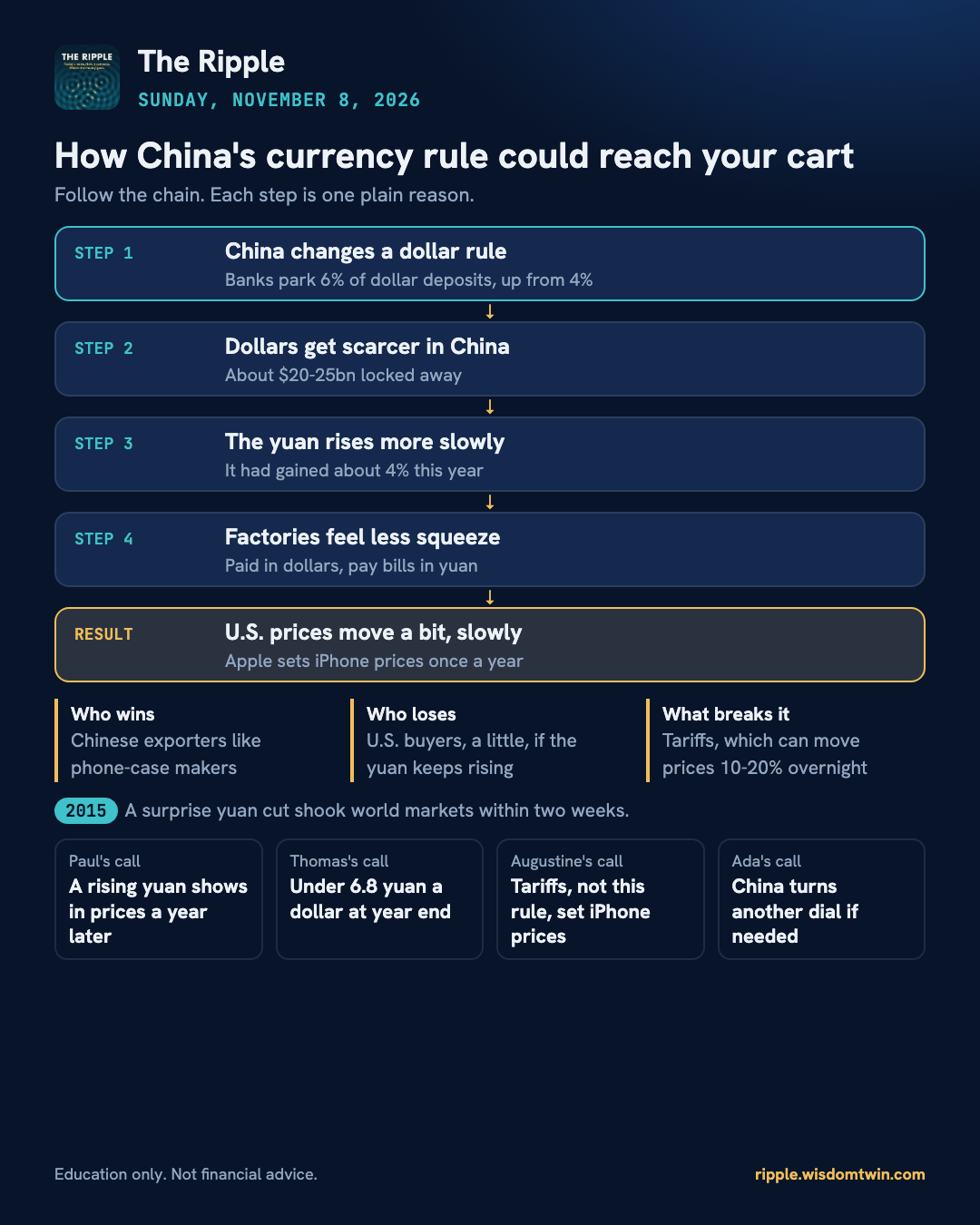
One email a day. Unsubscribe any time. Education, not financial advice.How China's currency rule could reach your cart
Follow the chain. Each step is one plain reason.
- STEP 1China changes a dollar ruleBanks park 6% of dollar deposits, up from 4%
- STEP 2Dollars get scarcer in ChinaAbout $20-25bn locked away
- STEP 3The yuan rises more slowlyIt had gained about 4% this year
- STEP 4Factories feel less squeezePaid in dollars, pay bills in yuan
- RESULTU.S. prices move a bit, slowlyApple sets iPhone prices once a year
Who winsChinese exporters like phone-case makers
Who losesU.S. buyers, a little, if the yuan keeps rising
What breaks itTariffs, which can move prices 10-20% overnight
2015 A surprise yuan cut shook world markets within two weeks.
Paul's callA rising yuan shows in prices a year later
Thomas's callUnder 6.8 yuan a dollar at year end
Augustine's callTariffs, not this rule, set iPhone prices
Ada's callChina turns another dial if needed
Read the script
# The Ripple Special: "Is China Defending Its Currency, and Does Your iPhone Care?"
*A special built on this week's news (Nov 3–8, 2026). About 1,500 spoken words, roughly 10 minutes.*
*Format: the panel show. Paul hosts. Politics only as cause and effect: no host takes a side on any country, party or politician.*
*Markup:*
- `[brackets]` are delivery tags.
- `(over)` lines play under the previous speaker.
- A line ending in "—" is cut off.
- `## ` headings are music breaks.
**Today's question:** China just moved to slow its currency. Does that reach the price of things Americans buy, like an iPhone, or is the link too weak to matter?
**The twist (said early):** China is defending the yuan against rising too fast, not falling.
**Little story:** an illustrative factory owner in Shenzhen, Mr. Chen, who makes phone cases and gets paid in dollars.
**History as proof:** August eleventh, twenty fifteen, China's surprise devaluation.
---
## COLD OPEN
**PAUL:** [provocative] Is China quietly defending its currency, and does that change what your iPhone costs?
**THOMAS:** [instantly] Yes. Obviously. China makes the phone, China moves the money, the phone gets cheaper. Next question.
**AUGUSTINE:** [dryly] Thomas has answered before hearing which way the money moved. A personal best.
**ADA:** [teasing] Four point two seconds. I timed it. I time everything.
**THOMAS:** Who times a person? That's so creepy.
**PAUL:** [laughs] Here's the news. On Tuesday, China's central bank changed a rule that most people have never heard of, for the first time in nearly five years. By the end you'll know what it does, how it can reach your shopping cart, and why the last time China surprised everyone, the whole world's stock markets fell. Issue one.
## ISSUE ONE: WHAT CHINA DID
**PAUL:** Ada, plain words.
**ADA:** Chinese banks hold deposits in foreign money, mostly dollars. They must park a slice of those dollars with the central bank. That slice is the foreign-exchange reserve requirement. On Tuesday it went from four percent to six percent. It starts November fifteenth.
**THOMAS:** Two percent. That's tiny.
**ADA:** One estimate from a big Chinese brokerage says it locks away about twenty to twenty-five billion dollars.
**THOMAS:** Okay, that's less tiny.
**PAUL:** And why would locking up dollars matter?
**ADA:** Fewer spare dollars inside China means dollars get a little scarcer there. Scarcer dollars cost more yuan. So the yuan stops climbing so fast.
**AUGUSTINE:** And there's the twist. Thomas said "defending." He's right. But China isn't stopping the yuan from falling.
**ADA:** It's stopping it from rising. The yuan gained about four percent against the dollar in the first nine months of this year, and it had risen fourteen trading days in a row. China's own news agency said the move was to ease the upward pressure.
**THOMAS:** [confused] Wait. Why would any country not want a stronger currency? That's like complaining your house is worth too much.
**PAUL:** Augustine, explain that one.
## ISSUE TWO: THE CHAIN TO YOUR CART
**AUGUSTINE:** Meet Mr. Chen. He's made up, but there are thousands like him. He runs a factory in Shenzhen making phone cases. He sells to America and gets paid in dollars. But his workers, his rent, his electricity, all in yuan.
**ADA:** Now say he sells a case for one dollar. When a dollar bought seven yuan, he got seven yuan. At six point six eight, he gets about six point six eight.
**THOMAS:** So he earns less without doing anything wrong.
**AUGUSTINE:** Exactly. A stronger yuan squeezes exporters. China's economy leans hard on exports. So Beijing likes the yuan steady, not racing.
**PAUL:** Now the iPhone. Ada, connect it.
**ADA:** If the yuan keeps rising, Chinese factories have two choices. Eat the loss, or raise their dollar prices. Let's take a part that costs one thousand yuan to make. At seven yuan a dollar, that's about one hundred forty-three dollars. At six point six eight, it's about one hundred fifty. About five percent more.
**THOMAS:** [excited] So China slowing the yuan keeps my phone cheaper! I was right!
**ADA:** You were right about the direction by accident. You thought it was falling.
**THOMAS:** Right is right, Ada.
**AUGUSTINE:** But here's where I push back. Your iPhone's price is set by Apple, in dollars, once a year. It isn't repriced every time the yuan twitches.
**ADA:** And much of the phone's cost isn't Chinese at all. The chips, the screen, the design, come from many countries. And a growing share of iPhones are now assembled in India.
**PAUL:** So does the yuan matter for American prices or not? Ada, the evidence.
**ADA:** [crisp] It's argued. Research led by the economist Gita Gopinath found that most world trade is priced in dollars, so currency moves pass into U.S. import prices slowly and only partly. In the short run, a small yuan move barely shows up in U.S. inflation. Over a year or two, a big, steady move can.
**THOMAS:** So "a bit, slowly." That's a boring answer.
**ADA:** Most true answers are boring. That's why you avoid them.
**THOMAS (over):** Paul, unplug her, please.
**PAUL:** Ha! And tariffs?
**AUGUSTINE:** They matter more than this rule. A tariff can move a price by ten or twenty percent overnight. This rule nudges a currency by a percent or two. Same ripple, smaller rock.
## THE FAR RIPPLE: AUGUST TWENTY FIFTEEN
**PAUL:** The far ripple. Augustine, prove that a quiet currency rule in China can shake the whole world.
**AUGUSTINE:** August eleventh, twenty fifteen. With no warning, China's central bank cut the yuan's daily reference rate by almost two percent. Its biggest one-day move in about twenty years.
**THOMAS:** Two percent again? Why did anyone care?
**AUGUSTINE:** Because of what it seemed to say. Markets read it as: China's economy is weaker than it admits. Over three days the yuan fell about three percent.
**ADA:** Then money started leaving China. People swapped yuan for dollars before it fell more. To stop the slide, China sold dollars from its savings. Its foreign reserves went from almost four trillion dollars at the peak in twenty fourteen to just under three trillion by January twenty seventeen.
**THOMAS:** A trillion dollars? Gone?
**ADA:** Not all spent defending the yuan. Some was just other currencies losing value against the dollar. Economists still argue how much was a real defense.
**PAUL:** And the world?
**AUGUSTINE:** August twenty-fourth. Shanghai fell eight and a half percent in one day. In New York, the Dow dropped more than a thousand points right after the open.
**ADA:** And a month later, America's central bank, the Fed, held off on its first rate rise in nearly a decade. Its statement pointed to recent global economic and financial developments.
**PAUL:** So China delayed a U.S. rate rise?
**ADA:** [carefully] That's the disputed link. The Fed had other worries too, like low U.S. inflation. It did raise rates that December. Fair to say China was one reason. Not the only one.
**AUGUSTINE:** And here's the mirror. In twenty fifteen China pushed the yuan down and the world panicked. This week China is holding the yuan back from going up, and almost nobody noticed.
**THOMAS:** Because a falling currency is scary and a rising one is just—
**ADA:** —inconvenient. For Mr. Chen.
**AUGUSTINE:** One more history note. China has used this exact rule before. It raised it twice in twenty twenty-one, to nine percent, when the yuan was also rising. Then cut it three times as the yuan weakened. It's a dial that turns both ways.
## THE SCALE
**PAUL:** The scale. Zero to ten. Ten means this rule will show up in what Americans pay for things made in China. Zero means you'll never feel it. Thomas.
**THOMAS:** Six. A stronger yuan has to show up somewhere. Factories can't eat losses forever.
**PAUL:** Augustine, your number.
**AUGUSTINE:** Two. Apple sets the price. Tariffs swamp the currency. This is a whisper in a loud room.
**PAUL:** Ada, your number.
**ADA:** Three. Small and slow. But if the yuan keeps climbing for a year, I'll raise it. I'll remember. I always remember.
**THOMAS:** That's a threat.
**PAUL:** I'm a three. The rule is about steadiness, not price tags. But steady is exactly what keeps your cart from changing.
## PREDICTIONS
**PAUL:** Predictions, with reasons. Thomas.
**THOMAS:** [confident] At the end of the year, a dollar will still buy fewer than six point eight yuan. Because China wants it slower, not lower.
**PAUL:** Augustine, your call.
**AUGUSTINE:** The next iPhone's U.S. price will be decided by tariffs and Apple's own costs, not by this rule. Because a one or two percent currency nudge is too small for Apple to chase.
**PAUL:** Ada, your call.
**ADA:** China will turn another dial if the yuan keeps rising fast after November fifteenth. Because this rule alone locks up only about twenty to twenty-five billion dollars, and that's small for a market that size.
**PAUL:** And mine. You won't see this in your next phone bill. But if you see the yuan climbing month after month, expect "made in China" to get a little pricier a year later. Because currencies move first, and prices follow slowly.
## CLOSE
**PAUL:** The calendar. The new rule starts November fifteenth, so watch the yuan that week. Thomas's six point eight call goes on the Friday Scorecard.
**ADA:** Timed, dated and filed.
**AUGUSTINE:** A small dial in Beijing.
**THOMAS:** A phone in my pocket.
**PAUL:** Follow the chain, not the headline. That's The Ripple.
**ADA:** [calmly] The Ripple is for education and information only. It is not financial advice. Do your own research, or talk to a licensed financial advisor before you invest.
---
Sources (9)
- Xinhua via People's Daily, Nov 4, 2026
- South China Morning Post on the ratio rise
- China Daily HK, Nov 3, 2026
- The Standard (Reuters), Nov 3, 2026
- FXStreet on MUFG's note
- Fortune, Aug 24, 2015
- Federal Reserve FOMC statement, Sept 17, 2015
- Gopinath et al., Dominant Currency Paradigm, AER 2020
- SAFE (China's FX regulator), official reserve data