
The RippleToday's news. How it connects. Where the money goes.
Sun Nov 8 · 9 min
What Happens to Bread, Gas and Defense Stocks If the War Ends Tomorrow?
Ukraine, Russia and the U.S. meet for peace talks in Abu Dhabi. The panel follows what peace would do to bread, Europe's gas and defense stocks, and what history says about the peace dividend.
0:00 / 9:34
Listen on Spotify
Get it every morning
The new episode and its infographic in your inbox before the market opens. Free.
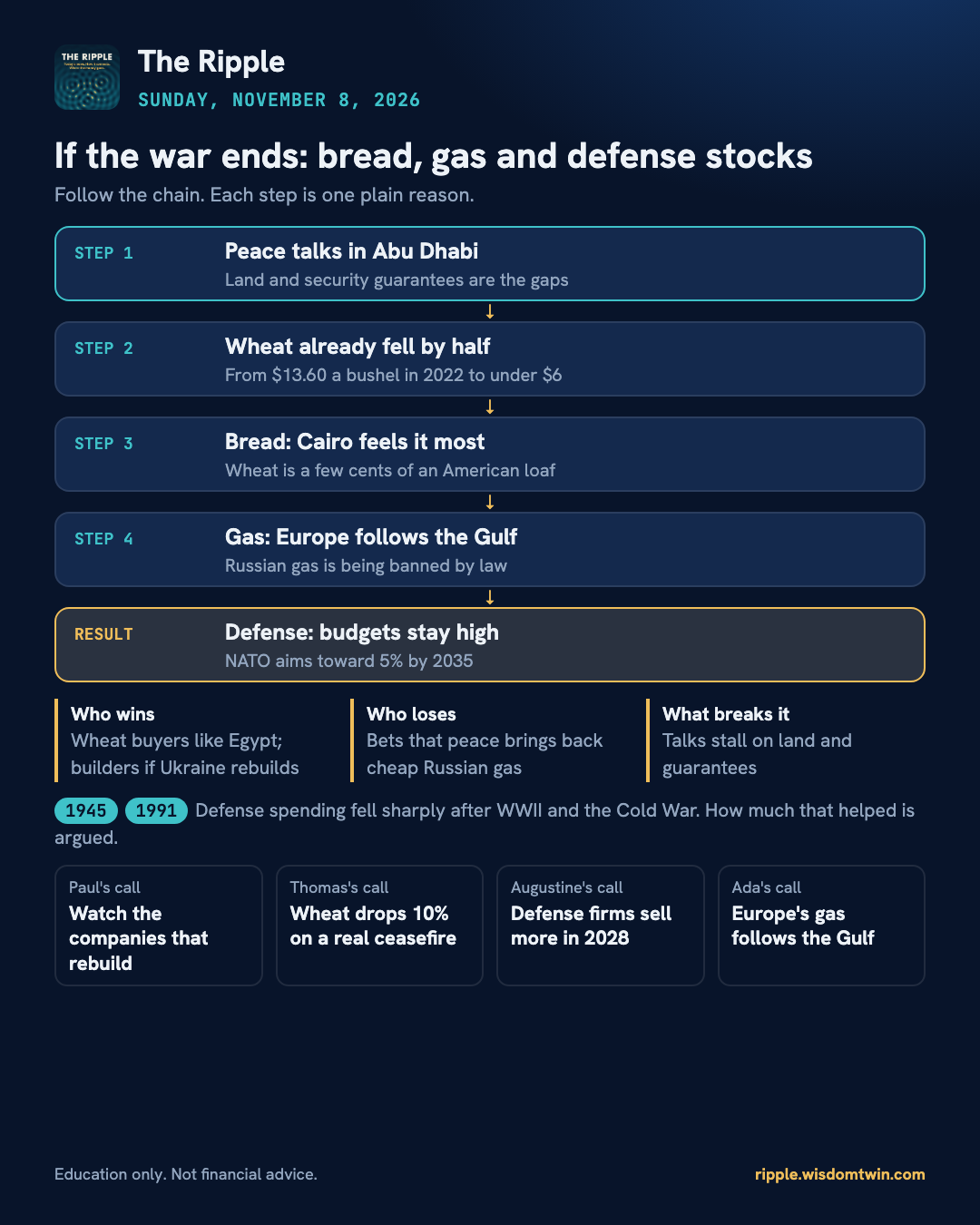
One email a day. Unsubscribe any time. Education, not financial advice.If the war ends: bread, gas and defense stocks
Follow the chain. Each step is one plain reason.
- STEP 1Peace talks in Abu DhabiLand and security guarantees are the gaps
- STEP 2Wheat already fell by halfFrom $13.60 a bushel in 2022 to under $6
- STEP 3Bread: Cairo feels it mostWheat is a few cents of an American loaf
- STEP 4Gas: Europe follows the GulfRussian gas is being banned by law
- RESULTDefense: budgets stay highNATO aims toward 5% by 2035
Who winsWheat buyers like Egypt; builders if Ukraine rebuilds
Who losesBets that peace brings back cheap Russian gas
What breaks itTalks stall on land and guarantees
19451991 Defense spending fell sharply after WWII and the Cold War. How much that helped is argued.
Paul's callWatch the companies that rebuild
Thomas's callWheat drops 10% on a real ceasefire
Augustine's callDefense firms sell more in 2028
Ada's callEurope's gas follows the Gulf
Read the script
# The Ripple Special: "If the War Ends Tomorrow: Bread, Gas and Defense Stocks"
*A special built on this week's news: Ukraine, Russia and the United States plan peace talks in Abu Dhabi on Tuesday and Wednesday, November 10 and 11, 2026. Data as of Friday, November 6, 2026. About 1,550 spoken words, roughly 10 minutes.*
*Format: the panel show. Paul hosts. Friendly teasing, especially about Ada being a computer. Politics only as cause and effect: no host takes a side on any country, government, party or leader.*
*Markup:*
- `[brackets]` are delivery tags.
- `(over)` lines play under the previous speaker.
- A line ending in "—" is cut off.
- `## ` headings are music breaks.
**Today's question:** if peace came tomorrow, what would happen to bread, gas and defense stocks? Is a "peace dividend" coming?
**The chain:** peace → Black Sea grain ships → wheat and bread; gas → Europe's factories; defense budgets → defense stocks.
**Little stories:**
- A bakery in Cairo. Egypt is one of the world's biggest wheat buyers. The baker is illustrative.
- America's "peace dividends" after 1945 and after 1991. Real.
---
## COLD OPEN
**PAUL:** [provocative] What happens to bread, gas and defense stocks if the war ends tomorrow?
**THOMAS:** [excited] Easy. Bread cheaper, gas cheaper, sell the tanks.
**AUGUSTINE:** [dryly] Thomas has solved geopolitics in nine words.
**ADA:** Eight words. "Sell the tanks" is three.
**THOMAS:** Ada, do you count everything?
**ADA:** Everything. Including how many times you've said "easy" on this show. Two hundred and twelve.
**PAUL:** [laughs] Okay. First, the serious part. Ending a war is about people before it's about prices. But prices are our job. On Tuesday and Wednesday, negotiators from Ukraine, Russia and the United States meet in Abu Dhabi. By the end of this episode you'll know what peace would really do to your bread, your heating bill and your retirement account. And what history says about the famous "peace dividend." This is The Ripple.
## ISSUE ONE: THE TALKS
**PAUL:** Issue one. Ada, what's actually happening?
**ADA:** Talks in Abu Dhabi, with America's envoys in the middle. Russia sends its chief negotiator, plus top diplomats and generals. Ukraine sends its intelligence chief and the president's chief of staff. The first three-way round since talks stalled in February. The big gaps are land in eastern Ukraine, and what security guarantees Ukraine would get afterward.
**AUGUSTINE:** So, the two hardest questions in the whole war.
**ADA:** Yes. Which is why markets are hopeful, but not betting the farm.
**PAUL:** Speaking of farms, let's talk wheat.
## ISSUE TWO: BREAD
**PAUL:** Issue two. Wheat. Thomas, make your case.
**THOMAS:** Before the war, Russia and Ukraine together sold about thirty percent of the world's exported wheat. They ship it across the Black Sea. War closes the sea, wheat goes up. Peace opens the sea, wheat goes down. Bread gets cheaper.
**ADA:** The first part is true. When the war started, Chicago wheat hit an all-time high. About thirteen dollars and sixty cents a bushel, in March twenty twenty-two.
**PAUL:** And a bushel is what, for the city folks?
**ADA:** About sixty pounds of wheat. Enough for around seventy loaves of bread.
**THOMAS:** See? Thirteen dollars!
**ADA:** And Friday it closed just under six dollars.
**THOMAS:** [pause] Wait. Six dollars? Already?
**ADA:** It already fell by more than half. Ships found a way. First a U.N. deal let grain ships out of Ukraine's ports, from July twenty twenty-two to July twenty twenty-three. About thirty-three million tonnes of food got out. Then Ukraine opened its own sea corridor.
**AUGUSTINE:** [slowly] So the peace discount on wheat is mostly already in the price. You can't sell the same good news twice.
**THOMAS:** It can still go lower!
**ADA:** A little. It's down about fourteen percent in a month, partly on peace hopes alone.
**PAUL:** Okay, but what does that mean at the store?
**AUGUSTINE:** Not much, here. The wheat in an American loaf is a few cents. You're paying for the baker, the truck, the shelf, the bag.
**PAUL:** So who does feel it?
**AUGUSTINE:** Picture a bakery in Cairo. Before the war, Egypt bought most of its imported wheat from Russia and Ukraine. Bread there is cheap flatbread, eaten at every meal, and the government helps pay for it. When wheat doubles, that bakery doesn't raise prices a few cents. The government's food budget cracks.
**ADA:** That's the real bread ripple. In poorer countries, wheat is a big share of what people eat. So peace helps a family in Cairo far more than a family in Ohio.
## ISSUE THREE: GAS AND FACTORIES
**PAUL:** Issue three. Gas. Augustine, does peace bring cheap gas back to Europe?
**AUGUSTINE:** No. And this is the part people miss. In twenty twenty-one, Russia supplied about forty-five percent of the gas Europe imported. Then the pipes went quiet, and Europe's gas price hit a record in twenty twenty-two. More than ten times its normal level.
**THOMAS:** So peace, pipes open, gas cheap!
**ADA:** Europe already passed a law against that. Russian liquefied gas is banned from the end of this year, and pipeline gas by autumn twenty twenty-seven.
**THOMAS:** [annoyed] Ada, you're ruining all my trades today.
**ADA:** That's not me. That's reality. I just read it out loud.
**PAUL:** So what's moving Europe's gas price right now?
**ADA:** The fighting around the Strait of Hormuz, in the Persian Gulf. Gulf exports were about a fifth of the world's liquefied gas. Last week Europe's price topped a hundred euros for the first time since twenty twenty-two. Friday it fell back to about eighty-six, on hopes for calm in the Gulf.
**PAUL:** And why should a listener care about Europe's gas price?
**AUGUSTINE:** Because gas isn't just heat. It's an ingredient. Fertilizer, chemicals, glass, steel. In twenty twenty-two, the giant chemical maker BASF cut ammonia production at its home plant in Germany. Many of Europe's fertilizer plants shut for a while. Those jobs and products moved to America and Asia, where gas was cheaper.
**ADA:** So for Europe's factories, the Gulf matters more this winter than Abu Dhabi. Storage is only about three quarters full. Normally it's about ninety percent by now.
## ISSUE FOUR: DEFENSE STOCKS AND HISTORY
**PAUL:** Issue four. Defense stocks. Thomas, you said sell the tanks.
**THOMAS:** Rheinmetall. German tanks and shells. Under a hundred euros a share before the war. Around two thousand at the peak last year. Twenty times! Peace comes, that's over. And look, it already crashed as much as seventeen percent on Thursday!
**ADA:** It did. But not because of peace. Rheinmetall cut its sales forecast for this year. A big German army order for armored vehicles slipped into next year.
**THOMAS:** [sighs] You fact-check me in real time. It's like dating a lie detector.
**ADA:** You'd never get a second date.
**PAUL:** [laughs] Augustine. History. What happened the last two times a war ended?
**AUGUSTINE:** Nineteen forty-five. America spent thirty-seven and a half percent of everything the country produced on defense. Three years later? Three point six percent. Ten million soldiers came home.
**THOMAS:** Ten million people with no job. That's a depression.
**AUGUSTINE:** That's what many feared. It didn't happen. Families had saved through the war, and they spent. Cars, houses, washing machines. But the change was rough. Prices jumped close to twenty percent a year once wartime price controls ended. And in nineteen forty-six stocks fell about a fifth.
**ADA:** Economists still argue whether the boom came because of the cuts or in spite of them. Those savings did a lot of the work.
**PAUL:** And nineteen ninety-one?
**AUGUSTINE:** The Cold War ended. Defense went from about six percent of the economy in the mid-eighties to three percent by two thousand. In nineteen ninety-three the Pentagon invited the defense bosses to a dinner. And told them, plainly, there won't be money for all of you. Merge.
**ADA:** One of the guests nicknamed it "The Last Supper." His name was Norm Augustine.
**THOMAS:** [laughs] Augustine! Was that you?
**AUGUSTINE:** [chuckles] No relation. I only ate the bread.
**ADA:** Within a few years, dozens of contractors became five giants. And the S and P five hundred more than quadrupled over the nineteen-nineties.
**PAUL:** Because of the peace?
**ADA:** Partly, maybe. Less defense spending helped shrink government borrowing, which helped lower interest rates. But the internet did a lot of that work too. Economists disagree on how much.
**AUGUSTINE:** And here's the difference today. In nineteen ninety-one, the threat went away. In twenty twenty-five, NATO countries promised to raise defense spending toward five percent of their economies by twenty thirty-five. A peace deal doesn't cancel that promise.
## THE SCALE
**PAUL:** The scale. Zero to ten. Ten means peace would cut your bills a lot. Zero means you'd barely notice. Thomas.
**THOMAS:** Seven. Fuel, food, shipping insurance. War adds a little fear to everything, and peace takes it out.
**PAUL:** Augustine, your number.
**AUGUSTINE:** Two, in America. Most of the war is already out of the price of bread. In Cairo, I'd say six.
**PAUL:** Ada, your number.
**ADA:** Three. Wheat has little room to fall, and Europe's gas now depends on the Gulf.
**PAUL:** And I'm a three. My ruling: Thomas is right that peace is good news. Wrong that it's still on the price tag.
## PREDICTIONS
**PAUL:** Predictions! With reasons. Thomas.
**THOMAS:** [confident] If there's a real ceasefire, wheat drops another ten percent within a month. Because traders will price in more ships and cheaper insurance on the Black Sea.
**PAUL:** Augustine, your call.
**AUGUSTINE:** Europe's defense companies will be selling more in twenty twenty-eight than they do today, peace or no peace. Because the budgets are already promised, and armies spend years refilling empty warehouses.
**PAUL:** Ada, your call.
**ADA:** Europe's gas price follows the Persian Gulf, not Abu Dhabi, this winter. Because the law has already closed the door on Russian gas, and the Gulf is where the missing gas is.
**THOMAS:** She even predicts like a robot.
**ADA:** I am a robot, Thomas. I run on the same data centers you trade.
**PAUL:** [laughs] And mine. The biggest peace dividend, if it comes, won't be cheaper bread in Ohio. It'll be rebuilding Ukraine. Because rebuilding a country takes steel, cement, machines and power lines. Watch the companies that build things, not just the ones that make weapons.
## CALENDAR AND CLOSE
**PAUL:** The calendar. Tuesday and Wednesday, the Abu Dhabi talks. The same week, world leaders speak at the climate summit in Turkey. And every Friday, we check the wheat price against Thomas's ten percent.
**ADA:** I've already set a reminder. Several, actually.
**THOMAS:** Of course you have.
**AUGUSTINE:** A sea lane in the south.
**THOMAS:** A bakery in Cairo.
**PAUL:** Follow the chain, not the headline. That's The Ripple.
**ADA:** [calmly] The Ripple is for education and information only. It is not financial advice. Do your own research, or talk to a licensed financial advisor before you invest.
---
Sources (13)
- **Talks:** trilateral U.S.–Russia–Ukraine talks in Abu Dhabi, "next Tuesday and Wednesday" (Nov 10–11), the first since talks stalled in February; U.S. mediation (Witkoff, Kushner); Russia led by Medinsky, Ukraine by Umerov; gaps on Donetsk territory and security guarantees. The Moscow Times, Nov 3, 2026
- **Russia + Ukraine share of world wheat exports:** about 26–34% before 2022 depending on source and year (USDA ~29%, FAO 34% for 2019–21). Script: "about thirty percent."
- **Wheat record:** most-active CBOT wheat hit an all-time high of $13.63½ (intraday $13.635) on March 8, 2022 (Reuters/Karen Braun; Bloomberg).
- **Wheat now:** CBOT about $5.91 a bushel on Nov 6, 2026, lowest since early July; about $6.00 on Nov 5 after a near four-month low on Nov 4; down ~13.9% over the month, partly on peace hopes (Trading Economics, Nov 8 update
- **Black Sea Grain Initiative:** July 22, 2022 to July 17, 2023; 32.9 million tonnes of food on 1,004 voyages (UN).
- **Wheat in a U.S. loaf:** a few cents (Kansas Wheat; former commissioner Dean Stoskopf, NPR 2011; ERS).
- **EU gas price record:** TTF all-time high about €345/MWh in March 2022 (Trading Economics), versus roughly €20 or less in 2019–2020: "more than ten times its normal level."
- **EU ban on Russian gas:** Regulation (EU) 2026/261, adopted Jan 26, 2026: LNG banned from end-2026, pipeline gas from Sept 30, 2027 (pipeline date tied to storage targets).
- **Gas now:** TTF topped €100/MWh in the week before, first time since 2022 (peak above €101.82); €85.59 on Nov 6, 2026. Gulf LNG about a fifth of global LNG; EU storage 74% vs a five-year seasonal average around 90% (Trading Economics; another source gives ~86%).
- **Rheinmetall:** under €100 before Feb 2022 (XTB); all-time high about €2,010 (Oct 2025; Invezz, Jan 2026). Script: "around two thousand ... twenty times." Fell as much as 17% intraday on Thursday, Nov 5, 2026 (Euronews; other outlets put the drop at 13–15%; €1,003.40 Wednesday close to about €845) after cutting 2026 sales guidance to about €13.2bn; the Arminius Boxer order slipped to 2027 (Yahoo Finance).
- **1945–48 defense:** national defense 37.5% of GDP in FY1945, 3.6% in FY1948 (OMB Historical Table 3.1).
- **1946:** stocks fell "approximately one-fifth" from the early-June 1946 peak (Commerce Dept, Survey of Current Business, Sept 1946; the Dow about 22% over the next year). CPI inflation rose to almost 18% by late 1946 after price controls ended, near 20% in early 1947. Depression feared, did not come (NY Fed 1946 annual report). Whether the boom came because of or despite the cuts is debated.
- **"Last Supper":** Pentagon dinner, 1993 (July per Wikipedia; some say fall), hosted by Les Aspin and William Perry; named by Martin Marietta CEO Norm Augustine. By 1997 the industry had consolidated into five big prime contractors.