
The RippleToday's news. How it connects. Where the money goes.
Sun Nov 8 · 9 min
Why Is Britain Still Paying for Liz Truss?
The Bank of England raised rates this week, and people asked if a 2022 budget is still in their mortgage. The panel follows the chain from gilts to pension funds to the kitchen table.
0:00 / 9:56
Listen on Spotify
Get it every morning
The new episode and its infographic in your inbox before the market opens. Free.
One email a day. Unsubscribe any time. Education, not financial advice.How a 2022 budget reached British mortgages
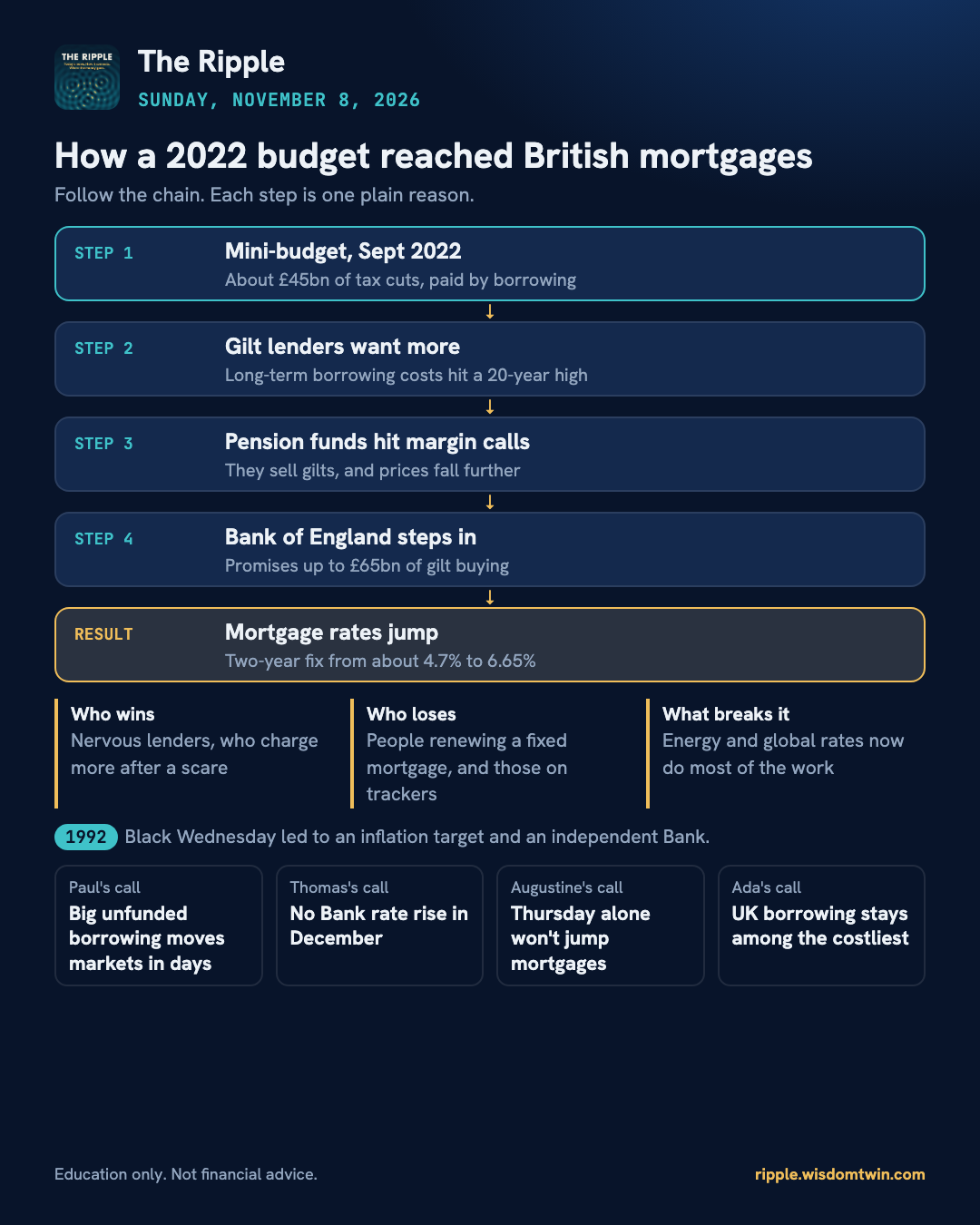
Follow the chain. Each step is one plain reason.
- STEP 1Mini-budget, Sept 2022About £45bn of tax cuts, paid by borrowing
- STEP 2Gilt lenders want moreLong-term borrowing costs hit a 20-year high
- STEP 3Pension funds hit margin callsThey sell gilts, and prices fall further
- STEP 4Bank of England steps inPromises up to £65bn of gilt buying
- RESULTMortgage rates jumpTwo-year fix from about 4.7% to 6.65%
Who winsNervous lenders, who charge more after a scare
Who losesPeople renewing a fixed mortgage, and those on trackers
What breaks itEnergy and global rates now do most of the work
1992 Black Wednesday led to an inflation target and an independent Bank.
Paul's callBig unfunded borrowing moves markets in days
Thomas's callNo Bank rate rise in December
Augustine's callThursday alone won't jump mortgages
Ada's callUK borrowing stays among the costliest
Read the script
# The Ripple Special: "Why Is Britain Still Paying for Liz Truss?"
*A special built on this week's news (Nov 3–8, 2026). About 1,500 spoken words, roughly 10 minutes.*
*Format: the panel show. Paul hosts. Politics only as cause and effect: no host takes a side on any party or politician.*
*Markup:*
- `[brackets]` are delivery tags.
- `(over)` lines play under the previous speaker.
- A line ending in "—" is cut off.
- `## ` headings are music breaks.
**Today's question:** is a four-year-old budget still in the price of a British mortgage, or is that a myth?
**Little story:** an illustrative couple in Leeds, Priya and Tom, who fixed their mortgage in twenty twenty-one and renew next month.
**History as proof:** Black Wednesday, September sixteenth, nineteen ninety-two.
---
## COLD OPEN
**PAUL:** [provocative] Why is Britain still paying for Liz Truss? She was prime minister for forty-nine days. Four years ago. And people are arguing it's still in their mortgage bill this week.
**THOMAS:** [scoffs] Come on. That's like blaming your hangover on a party from twenty twenty-two.
**AUGUSTINE:** [dryly] Some parties are memorable, Thomas.
**ADA:** [teasing] I remember every party. I just wasn't invited to any of them.
**THOMAS:** Because you'd fact-check the toast.
**PAUL:** [laughs] Here's the news. On Thursday, the Bank of England raised its main interest rate a quarter point, to four percent. First rise since twenty twenty-three. By the end of this episode you'll know how one budget, a pension fund and a mortgage are wired together, and whether that wire is still live. Issue one.
## ISSUE ONE: THIS WEEK
**PAUL:** Ada, why did the Bank raise rates?
**ADA:** Inflation went back up. Three and a half percent in September. Energy prices keep rising with the conflict in the Middle East, and the Bank now expects inflation to peak around five percent by the middle of next year. The vote was eight to one, and the one wanted an even bigger rise.
**THOMAS:** So it's oil. Not Truss. Done. Short episode.
**PAUL:** Wrong! Not done. Augustine, why are we even talking about twenty twenty-two?
**AUGUSTINE:** Because the question isn't why the Bank moved. It's why Britain pays more to borrow than it might have. Markets have long memories. Longer than Thomas.
**THOMAS:** Everyone's memory is longer than mine. That's a low bar.
## ISSUE TWO: THE CHAIN
**PAUL:** Issue two. The chain, one link at a time. Ada, September twenty-third, twenty twenty-two.
**ADA:** The government's mini-budget. About forty-five billion pounds of tax cuts, on top of a big energy support plan. Supporters said lower taxes would lift growth. The catch for markets: it would be paid for with borrowing, and it came without the usual independent forecast from the budget watchdog.
**THOMAS:** Wait, so what? Governments borrow all the time.
**ADA:** They do. But when you borrow, you sell bonds. In Britain those are called gilts. A gilt is an I O U from the government. If lots of new I O U's are coming, and lenders get nervous, they want a higher interest rate to hold them.
**AUGUSTINE:** Like lending money to a cousin who just bought a boat. You'll still lend. But you want more back.
**PAUL:** And they wanted a lot more. Ada?
**ADA:** Yields, the interest rate on those gilts, jumped. The thirty-year gilt saw its biggest monthly rise since nineteen ninety-four. Over a few days, long-term borrowing costs hit their highest in about twenty years.
**PAUL:** Now the link nobody saw coming. Pension funds. Thomas, you look confused.
**THOMAS:** I'm always confused. That's my brand. Why would a pension fund care?
**ADA:** Many British pension funds used a strategy called L D I, liability-driven investment. Think of it as buying gilts with borrowed money, as a hedge. Fine when gilt prices are calm. But when gilt prices crash, the lender asks for cash. Right now. That's called a margin call.
**THOMAS:** And they don't have the cash.
**ADA:** So they sell gilts to raise it. Which crashes gilt prices further. Which triggers more margin calls.
**AUGUSTINE:** [slowly] A fire that sells its own fire extinguishers.
**PAUL:** So on September twenty-eighth, the Bank of England stepped in.
**ADA:** It promised to buy up to sixty-five billion pounds of long-dated gilts. In the end it used only about nineteen billion. The Bank said later that without it, many of those funds would have run out of money. Thirty-year yields fell more than one percentage point that same day.
**PAUL:** And here's where your kitchen table comes in. Mortgages.
**ADA:** British banks price fixed mortgages off market rates, not just the Bank's rate. So when markets panicked, lenders pulled deals. Product choice fell to a twelve-year low. The average two-year fixed rate went from about four point seven percent on budget day to six point six five percent by October twentieth.
**PAUL:** Make that real money.
**ADA:** On a two hundred thousand pound mortgage over twenty-five years, that's roughly two hundred and thirty pounds more every month. Almost two thousand eight hundred a year.
**THOMAS:** [quietly] Okay. That's a car payment.
**AUGUSTINE:** Within weeks, the chancellor was replaced, most of the tax cuts were reversed, and the prime minister resigned. Markets calmed. That part of the story is not in dispute.
## ISSUE THREE: IS IT STILL IN THE BILL?
**PAUL:** Issue three. The fight. Is any of that still in today's price? Thomas, you first.
**THOMAS:** No! Mortgage rates went down again within months. Since then it's been global stuff. Inflation everywhere, America, energy. Truss is a ghost story.
**AUGUSTINE:** Ghosts are real if people pay to avoid the house.
**THOMAS:** That makes no sense, and I hate that it sounds wise.
**ADA:** [crisp] Here's what the evidence says, and it splits. Britain's own think tank, N I E S R, tracked the extra premium investors demanded and called it a blip that corrected fairly quickly. Capital Economics found it partly unwound, with some left over. Others, like the credit insurer Allianz Trade, put a big ongoing cost on political turmoil in general, not just that one budget.
**PAUL:** So economists genuinely disagree.
**ADA:** They do. Separating a budget from inflation, energy and global rates is hard. Anyone who gives you an exact number for "the Truss premium" is guessing.
**AUGUSTINE:** But here's the part that isn't a guess. The Bank, and the markets, learned something about Britain. Its pension plumbing could break. And that's not forgotten. Every budget since has been watched with that in mind.
**PAUL:** Ada, the little story.
**ADA:** Priya and Tom, a couple in Leeds. They're made up, but there are many like them. In twenty twenty-one they fixed for five years at about two percent. Their deal ends next month.
**THOMAS:** Ooh. Renewal month. That's brutal.
**ADA:** On two hundred thousand pounds, at two percent, they paid about eight hundred and fifty a month. If they renew around four and a half percent, that's about eleven hundred and ten. Roughly two hundred and sixty more a month.
**THOMAS:** But that's not Truss! That's the whole world's rates going up!
**ADA:** Mostly, yes. Thomas is right about that.
**THOMAS:** [excited] Write it down! Ada said I'm right!
**ADA:** I said mostly. I keep receipts. That one's in pencil.
## THE FAR RIPPLE: BLACK WEDNESDAY
**PAUL:** The far ripple. Augustine, give me proof that one bad week can echo for decades.
**AUGUSTINE:** September sixteenth, nineteen ninety-two. Black Wednesday. Britain had tied the pound to other European currencies in a system called the E R M. Traders, George Soros the most famous, bet the pound was too high. The Bank raised rates from ten percent to twelve in one day, then announced fifteen.
**THOMAS:** Fifteen percent? For a mortgage?
**AUGUSTINE:** And it didn't work. That evening Britain left the system. The Treasury later put the cost at about three point three billion pounds. Soros reportedly made around a billion dollars.
**ADA:** And then the twist. Freed from the peg, rates came down fast. Within weeks Britain adopted an inflation target. Five years later, in nineteen ninety-seven, the Bank of England was given independence to set rates on its own.
**PAUL:** So Thursday's decision, made by a committee, not a politician—
**AUGUSTINE:** —is a grandchild of Black Wednesday. Yes.
**ADA:** One honest note. Some economists call it "White Wednesday," because the economy grew strongly after. Whether leaving was good or bad is still argued.
**THOMAS:** Thirty-four years of arguing. Sounds like this panel.
## THE SCALE
**PAUL:** The scale. Zero to ten. Ten means the twenty twenty-two budget is still a big part of what Britain pays to borrow today. Zero means it's gone. Thomas.
**THOMAS:** Two. Energy and inflation are doing the work now. Let the ghost rest.
**PAUL:** Augustine, your number.
**AUGUSTINE:** Five. The premium faded. The memory didn't. Markets now pounce faster on any British budget.
**PAUL:** Ada, your number.
**ADA:** Three. The research mostly says it faded. But I'm a three with a long footnote.
**THOMAS:** Your footnotes have footnotes.
**PAUL:** I'm a four. The direct cost faded, but a nervous lender charges you for the last scare. That's the ripple.
## PREDICTIONS
**PAUL:** Predictions, with reasons. Thomas.
**THOMAS:** [confident] The Bank won't raise again in December. Because this rise is about energy, and if oil calms down, they'll want to wait and see.
**PAUL:** Augustine, your call.
**AUGUSTINE:** Mortgage rates won't jump much from Thursday alone. Because lenders had already priced a rise in. The people who'll feel it most are those on trackers and those renewing, like Priya and Tom.
**PAUL:** Ada, your call.
**ADA:** British borrowing costs will stay among the highest of the big rich countries into next year. Because inflation there is higher, and markets still watch British budgets more closely than most. And no, I won't sleep on it.
**THOMAS:** You never sleep. Unplug her.
**PAUL:** [laughs] And mine. The next time any government, anywhere, announces big borrowing without a forecast, markets will move within days, not months. Because twenty twenty-two taught everyone how fast it can happen.
## CLOSE
**PAUL:** The calendar. China's currency rule change kicks in on November fifteenth, and the Bank of England's next decision is December seventeenth. Thomas's December call goes on the Friday Scorecard.
**ADA:** This time, in ink.
**AUGUSTINE:** Forty-nine days in office.
**THOMAS:** Four years of arguing.
**PAUL:** Follow the chain, not the headline. That's The Ripple.
**ADA:** [calmly] The Ripple is for education and information only. It is not financial advice. Do your own research, or talk to a licensed financial advisor before you invest or choose a mortgage.
---
Sources (10)
- Bank of England Monetary Policy Summary, November 2026
- BoE, Financial Stability Report Dec 2022, opening remarks
- Bank Underground, assessing the BoE's response to the LDI crisis
- IMF, Lessons from the UK's LDI crisis
- Mortgage Solutions on Moneyfacts, Oct 2022
- MoneySavingExpert, Nov 2022 (6.65% on Oct 20)
- NIESR, UK gilt yields one year on from the mini-budget
- Capital Economics, UK risk premium
- City AM on Allianz Trade's estimate
- Bank of England, history of Bank Rate and independence