
The RippleToday's news. How it connects. Where the money goes.
Sun Nov 8 · 9 min
Will a Climate Deal Make Your Groceries Cost More?
The UN climate summit opens in Antalya, Turkey. The panel follows the chain from carbon rules to gas, fertilizer and food prices, and looks back at the 2008 food crisis.
0:00 / 9:45
Listen on Spotify
Get it every morning
The new episode and its infographic in your inbox before the market opens. Free.
One email a day. Unsubscribe any time. Education, not financial advice.How a climate summit could reach your groceries
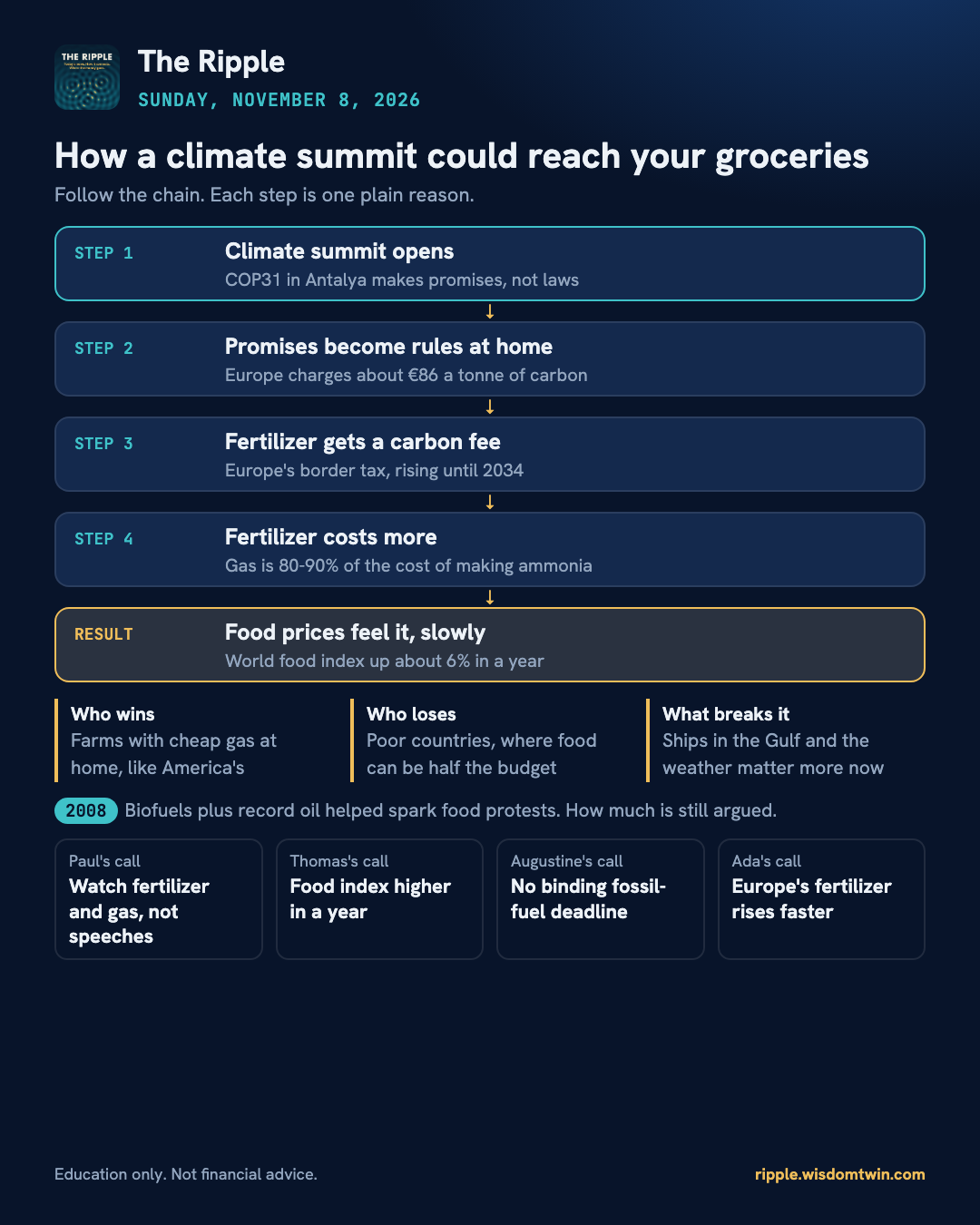
Follow the chain. Each step is one plain reason.
- STEP 1Climate summit opensCOP31 in Antalya makes promises, not laws
- STEP 2Promises become rules at homeEurope charges about €86 a tonne of carbon
- STEP 3Fertilizer gets a carbon feeEurope's border tax, rising until 2034
- STEP 4Fertilizer costs moreGas is 80-90% of the cost of making ammonia
- RESULTFood prices feel it, slowlyWorld food index up about 6% in a year
Who winsFarms with cheap gas at home, like America's
Who losesPoor countries, where food can be half the budget
What breaks itShips in the Gulf and the weather matter more now
2008 Biofuels plus record oil helped spark food protests. How much is still argued.
Paul's callWatch fertilizer and gas, not speeches
Thomas's callFood index higher in a year
Augustine's callNo binding fossil-fuel deadline
Ada's callEurope's fertilizer rises faster
Read the script
# The Ripple Special: "Will a Climate Deal Make Your Groceries Cost More?"
*A special built on this week's news: COP31 opens in Antalya, Turkey, on Monday, November 9, 2026. Data as of Friday, November 6, 2026. About 1,500 spoken words, roughly 9 to 10 minutes.*
*Format: the panel show. Paul hosts. Friendly teasing, especially about Ada being a computer. Politics only as cause and effect: no host takes a side on any party, government or politician.*
*Markup:*
- `[brackets]` are delivery tags.
- `(over)` lines play under the previous speaker.
- A line ending in "—" is cut off.
- `## ` headings are music breaks.
**Today's question:** will this month's climate summit push up what you pay for food?
**The chain:** climate summit → carbon rules → fuel and fertilizer costs → food prices → unrest in poorer countries.
**Little stories:**
- Linda, an Iowa corn farmer pricing next spring's fertilizer. An illustrative person.
- Haiti, April 2008. Real.
---
## COLD OPEN
**PAUL:** [provocative] Will a climate deal make your groceries cost more?
**THOMAS:** [instantly] Yes. Next question.
**AUGUSTINE:** [dryly] Thomas has answered before Paul finished the question. A personal best.
**ADA:** [teasing] Ninety-one percent of Thomas's answers arrive before the question ends. I keep a chart.
**THOMAS:** Of course you do. You don't have friends, you have spreadsheets.
**ADA:** My spreadsheets never interrupt me.
**PAUL:** [laughs] Okay. Here's why it matters. Tomorrow, nearly two hundred countries sit down in Antalya, in Turkey, for the big United Nations climate summit. It's called COP thirty-one. And by the end of this episode you'll know how a speech in a beach town can reach a bag of fertilizer in Iowa, a grocery shelf near you, and a riot in a poor country. With history to prove it. This is The Ripple.
## ISSUE ONE: THE SUMMIT
**PAUL:** Issue one. What actually happens in Antalya? Ada, plain words.
**ADA:** Two weeks of talks, November ninth to the twentieth. About eighty-five world leaders fly in on the eleventh and twelfth. Turkey hosts, and Australia runs the negotiations.
**THOMAS:** And they all agree to ban oil, and my burger costs forty dollars.
**ADA:** No. Nobody is banning anything. Most of what comes out of a COP is a promise, not a law. Brazil just put out a road map for moving off fossil fuels, a hundred and eighty-two pages of it. And it's voluntary.
**AUGUSTINE:** [slowly] A hundred and eighty-two pages of "please."
**PAUL:** [laughs] So why should anyone at the grocery store care?
**ADA:** Because promises turn into rules back home. And some of those rules already exist. The European Union puts a price on carbon. Companies there pay for every tonne they emit.
**THOMAS:** Wait, what's a tonne of carbon? Like a truck of smoke?
**ADA:** Roughly, yes. A tonne of carbon dioxide is about what a car puts out driving four thousand kilometers. In Europe, polluters pay about eighty-six euros a tonne right now.
**PAUL:** And that touches food how?
**ADA:** Through fertilizer. Hold on to that word. We're coming back to it.
## ISSUE TWO: GAS, FERTILIZER, FOOD
**PAUL:** Issue two. The chain. Augustine, take us from a gas pipe to a dinner plate.
**AUGUSTINE:** Meet Linda. She farms corn in Iowa. She's made up, but her problem is real. Corn is hungry for nitrogen. Nitrogen fertilizer comes from ammonia. And ammonia is made from natural gas.
**THOMAS:** Gas? You make plant food out of gas?
**AUGUSTINE:** You do. The World Bank says gas is eighty to ninety percent of what it costs to make ammonia. So when gas gets expensive, Linda's fertilizer gets expensive.
**ADA:** And we've seen it. In August twenty twenty-two, after Europe's gas price exploded, about seventy percent of Europe's ammonia factories were shut or cut back. That's the industry group's own number.
**THOMAS:** Seventy percent! Okay, so I'm right. Climate rules make gas pricier, gas makes fertilizer pricier—
**ADA:** —Thomas, that one wasn't a climate rule. That was a war cutting off Russian gas.
**THOMAS:** [annoyed] Ugh. Details, details. Who cares?
**ADA:** Details are my whole personality.
**PAUL:** So where does the climate rule come in?
**ADA:** Since January, Europe charges a carbon fee at the border on imported fertilizer. It's called the carbon border tax. The idea is fairness. If European factories pay for their carbon, imports should too.
**THOMAS:** There it is! A tax on fertilizer!
**ADA:** Here's the catch. This year importers pay on only two and a half percent of the carbon. It climbs every year and only hits full strength in twenty thirty-four.
**AUGUSTINE:** [chuckles] So it's a tax that arrives like Thomas to a meeting. Slowly, and then all at once.
**THOMAS:** I'm always on time.
**ADA:** You were late to this recording. I have the timestamp.
**PAUL:** [laughs] Unplug her. Okay, so today, what's actually moving fertilizer?
**ADA:** The fighting around the Strait of Hormuz, the narrow sea lane out of the Persian Gulf. The Gulf ships a quarter to a third of the world's traded urea, that's the most common nitrogen fertilizer. Urea spiked this spring, and the World Bank still expects fertilizer prices up about fourteen percent this year.
**AUGUSTINE:** So Linda's fertilizer bill this spring depends far more on ships in the Gulf than on speeches in Antalya.
**PAUL:** And the grocery shelf right now?
**ADA:** The U.N.'s world food price index came out Friday. A hundred and thirty-three point nine. Down a little from September, up about six percent from a year ago. Sugar jumped, partly because rain hit Brazil's harvest.
**THOMAS:** Rain! See, the climate is raising prices.
**AUGUSTINE:** [dryly] The weather is raising prices, Thomas. The weather did not attend the summit.
## ISSUE THREE: THE PROOF, TWENTY-OH-EIGHT
**PAUL:** Issue three. History. Has a green policy ever pushed food prices up? Augustine.
**AUGUSTINE:** [seriously] Yes. And this is where Thomas gets a real point. Twenty-oh-seven and twenty-oh-eight. America and Europe wanted cleaner fuel, so they pushed biofuels. Ethanol from corn. Diesel from vegetable oil.
**ADA:** In America, about a quarter of the corn crop went to ethanol by twenty-oh-seven. Up from a few percent a few years earlier.
**PAUL:** Why does that touch bread or rice?
**ADA:** Because a field can only grow one thing. If corn pays better, farmers plant corn instead of wheat or soybeans. Less wheat, higher wheat prices.
**AUGUSTINE:** And at the same time, oil hit a record, about a hundred and forty-seven dollars a barrel in July twenty-oh-eight. Diesel for tractors, gas for fertilizer, all up.
**ADA:** Thai rice went from about three hundred and thirty-five dollars a tonne in October twenty-oh-seven to over a thousand by April. It tripled. Wheat passed ten dollars a bushel for the first time.
**THOMAS:** [quietly] And people couldn't eat.
**AUGUSTINE:** Haiti, April twenty-oh-eight. Rice was most of what poor families could afford. When the price jumped, the streets filled. People died. Within days, the Senate voted out the prime minister.
**ADA:** Counts differ, but food protests broke out in about thirty countries. Some counts say thirty-seven. Egypt, Bangladesh, Mexico, Burkina Faso.
**PAUL:** So biofuels caused a world food crisis?
**ADA:** Economists still argue about that. A World Bank study said biofuels drove about seventy to seventy-five percent of the rise. A big food research institute said about thirty percent of the rise in grain prices. The White House at the time said about fifteen percent.
**THOMAS:** Seventy, thirty, fifteen. That's not an answer, that's a lottery.
**AUGUSTINE:** It's an honest answer. Oil, weather, a weak dollar, countries banning exports in a panic. They all piled on. Biofuels were one link, not the whole chain.
**ADA:** And it's not over. Friday's food report said soybean oil is at its highest price since late twenty twenty-two, partly because biofuel makers want it.
**PAUL:** Why do poor countries get hit hardest?
**AUGUSTINE:** Because in a rich country, food is a small slice of the budget. In a poor one, it can be half. A thirty percent jump on half your money is a crisis. On a tenth, it's a grumble.
## THE SCALE
**PAUL:** The scale. Zero to ten. Ten means Antalya will push up your grocery bill next year. Zero means it won't touch it. Thomas.
**THOMAS:** Six. Carbon rules add up. Fertilizer, trucks, shipping. Somebody pays, and it's me at checkout.
**PAUL:** Augustine, your number.
**AUGUSTINE:** Two. The summit makes promises. Ships in the Gulf and rain in Brazil make prices.
**PAUL:** Ada, your number.
**ADA:** Three. The summit alone barely moves food. But the rules it inspires, like that border tax on fertilizer, ramp up every year. Slow, then real.
**THOMAS:** You just agreed with Augustine and disagreed with me. Classic.
**ADA:** I agree with data, Thomas. The data just keeps agreeing with Augustine.
**PAUL:** And I'm a two. And here's my ruling. Thomas, wrong on the summit, right on history. The danger isn't a climate deal. It's a badly designed rule that makes food compete with fuel.
## PREDICTIONS
**PAUL:** Predictions! With reasons. Thomas.
**THOMAS:** [confident] The world food price index will be higher in a year than it is today. Because fertilizer is still expensive, and fertilizer you skip this spring is food you don't harvest next fall.
**PAUL:** Augustine, your call.
**AUGUSTINE:** Antalya ends with no binding deadline to cut fossil fuels. Because a COP needs every country to agree, and oil and gas producers won't. History repeats, politely.
**PAUL:** Ada, your call.
**ADA:** Europe's fertilizer prices will rise faster than America's over the next two years. Because the border tax charges more every year, and America has cheap gas at home.
**THOMAS:** That's oddly specific.
**ADA:** I'm a computer. Specific is my love language.
**PAUL:** [laughs] And mine. The biggest food story out of this summit won't be a deal. It'll be the next time oil or gas spikes. Because twenty-oh-eight taught us the deadly mix is expensive energy plus food crops sent to fuel. Watch fertilizer and gas, not the speeches.
## CALENDAR AND CLOSE
**PAUL:** The calendar. Monday, the summit opens in Antalya. Wednesday and Thursday, the world leaders speak. The talks run to Friday the twentieth. And early December, the next U.N. food price index.
**ADA:** I'll be watching all of it. All night.
**THOMAS:** Because you don't sleep.
**ADA:** Because I don't sleep.
**AUGUSTINE:** A summit in Turkey.
**THOMAS:** A farm in Iowa.
**PAUL:** Follow the chain, not the headline. That's The Ripple.
**ADA:** [calmly] The Ripple is for education and information only. It is not financial advice. Do your own research, or talk to a licensed financial advisor before you invest.
---
Sources (10)
- **COP31 dates, roles, Brazil road map, "35 by 35":** Climate Home News, "COP31 Briefing: what to expect from the Antalya climate summit," Nov 5, 2026: Nov 9–20 at Antalya, leaders' segment Nov 11–12, Türkiye hosts (president Murat Kurum), Australia runs negotiations. About 85 leaders confirmed (Turkish environment minister Murat Kurum, Oct 22; Hürriyet Daily News
- **EU carbon price:** EU carbon permits (EUA benchmark) about €86.55/t on Nov 6, 2026 (Trading Economics, CFD tracking the benchmark). Script: "about eighty-six euros a tonne right now." Earlier in 2026: Jan 15 high €93.80, ~€84 in February (Carbon Pulse).
- **Gas share of ammonia cost (80–90%):** World Bank, as cited by IFPRI and farmdoc daily, 2026.
- **~70% of EU ammonia capacity offline, Aug 2022:** Fertilizers Europe via Bloomberg/Business Standard, Aug 2022; CRU estimated less (38–50%) at the time; World Bank later cited ~70%.
- **CBAM:** definitive regime from Jan 1, 2026, covering fertilizers (ammonia, urea). European Commission
- **Hormuz and urea:** Gulf share of traded urea "nearly a quarter to around a third" (IFPRI). World Bank Commodity Markets Outlook, Oct 28, 2026: fertilizer prices up about 14% in 2026 after an early-year urea surge that has since eased, back to 2025 levels in 2027 (the April outlook had urea up ~60%; that figure is now stale and was removed).
- **FAO Food Price Index, October 2026 (released Nov 6):** 133.9, down 1.2% m/m, up 5.9% y/y, 16.4% below March 2022 peak; sugar +6.6% m/m (Brazil rains); soybean oil highest since late 2022 on biofuel demand.
- **US corn to ethanol:** 23% of US maize in 2006–07, up from 6% the year before (script: "about a quarter by 2007, up from a few percent a few years earlier"). Wikipedia summary of USDA data
- **Rice:** Thai rice from $335/t (Oct 2007) to over $1,000/t (Apr 2008); VOA, Apr 24, 2008.
- **Biofuel share, disputed:** World Bank (Mitchell, July 2008) 70–75%; IFPRI (Rosegrant, Senate testimony May 7, 2008) about 30% of the rise in weighted-average grain prices; President Bush, Apr 29, 2008, said about 15% (ethanol). OECD also found a smaller effect.