
The RippleToday's news. How it connects. Where the money goes.
Sun Nov 8 · 8 min
Why Does a Meeting in Doha Change What You Pay to Fly to Florida?
Oil had its steepest weekly drop since 2020 on peace hopes. The panel follows the chain from Doha to jet fuel to a Christmas ticket to Tampa, and asks why fares fall so slowly.
0:00 / 8:18
Listen on Spotify
Get it every morning
The new episode and its infographic in your inbox before the market opens. Free.
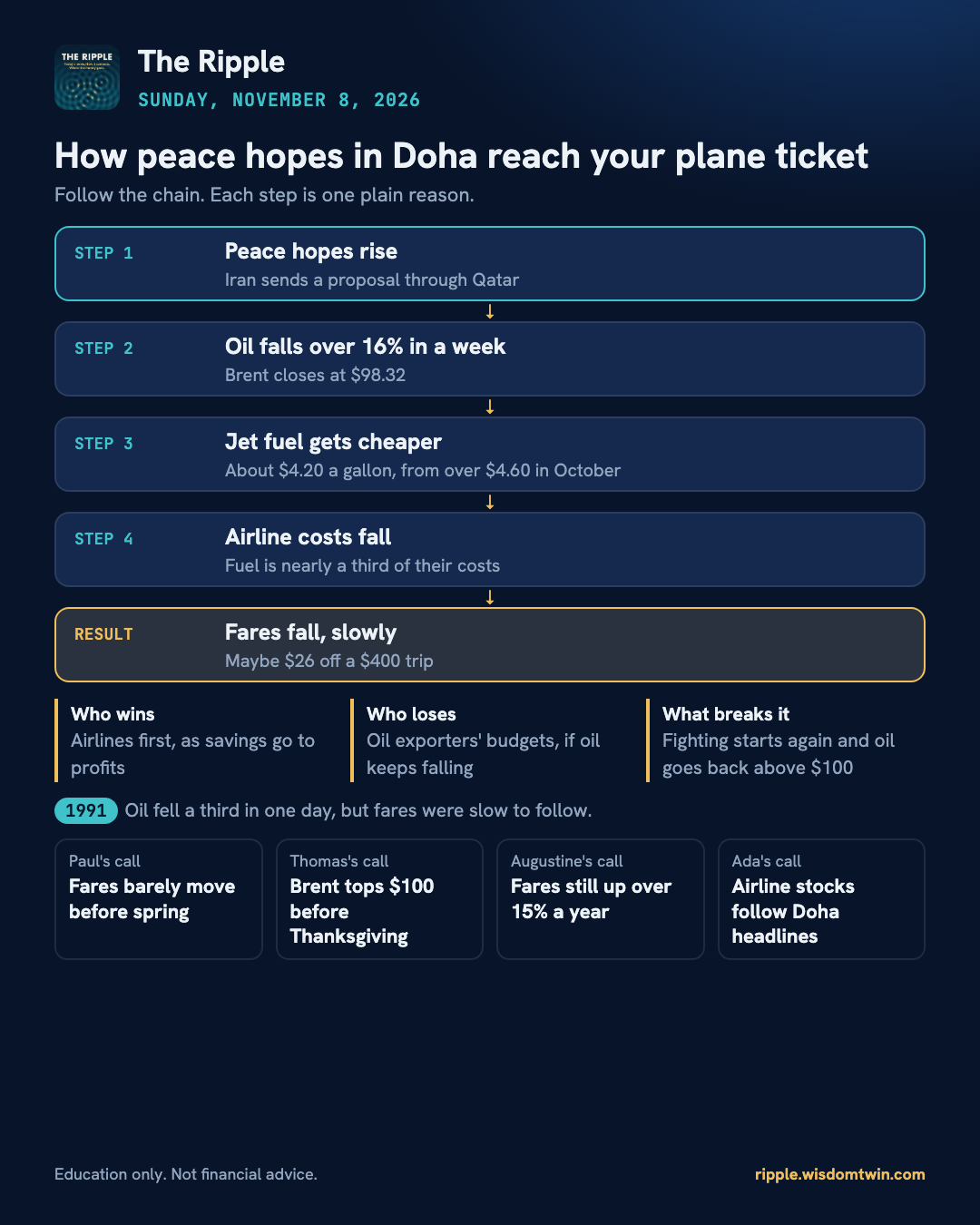
One email a day. Unsubscribe any time. Education, not financial advice.How peace hopes in Doha reach your plane ticket
Follow the chain. Each step is one plain reason.
- STEP 1Peace hopes riseIran sends a proposal through Qatar
- STEP 2Oil falls over 16% in a weekBrent closes at $98.32
- STEP 3Jet fuel gets cheaperAbout $4.20 a gallon, from over $4.60 in October
- STEP 4Airline costs fallFuel is nearly a third of their costs
- RESULTFares fall, slowlyMaybe $26 off a $400 trip
Who winsAirlines first, as savings go to profits
Who losesOil exporters' budgets, if oil keeps falling
What breaks itFighting starts again and oil goes back above $100
1991 Oil fell a third in one day, but fares were slow to follow.
Paul's callFares barely move before spring
Thomas's callBrent tops $100 before Thanksgiving
Augustine's callFares still up over 15% a year
Ada's callAirline stocks follow Doha headlines
Read the script
# The Ripple Special: "Doha to Tampa"
*A special built on this week's news (November 3 to 8, 2026). About 1,350 spoken words, roughly 9 minutes.*
*Format: the panel show. Paul hosts. Friendly teasing, especially about Ada being a computer. Politics and diplomacy only as cause and effect; no host takes a side.*
*Markup:*
- `[brackets]` are delivery tags.
- `(over)` lines play under the previous speaker.
- A line ending in "—" is cut off.
- `## ` headings are music breaks.
**Today's question:** If peace talks drop the price of oil, will your plane ticket get cheaper, and when?
**The chain:** peace hopes, so oil falls, so jet fuel falls, so airline costs fall, so fares (maybe, slowly) and airline profits; and on the far side, oil exporters' budgets.
**Little story:** Linda, an illustrative grandmother in Ohio, pricing flights to see her grandkids in Tampa over the holidays.
**History:** January 17, 1991. Oil fell about a third in one day as the Gulf War air campaign began.
---
## COLD OPEN
**PAUL:** [provocative] Why does a meeting in Doha change what you pay to fly to Florida?
**AUGUSTINE:** [dryly] Because the airlines read the news faster than they read your complaints.
**THOMAS:** [laughs] Okay, that's good.
**PAUL:** So my neighbor Linda, well, let's call her Linda, wants to fly from Ohio to Tampa to see her grandkids at Christmas. And she asked me, "Oil just crashed. Should I wait for cheaper tickets?" By the end of this one, you'll know the whole chain from a peace offer in Qatar to her boarding pass, and what happened the last time oil fell off a cliff.
**ADA:** I could book it for her right now. I don't even need a window seat.
**THOMAS:** You don't need a seat at all, Ada. You fly as an email.
**PAUL:** [laughs] This is The Ripple.
## ISSUE ONE: THE OIL DROP
**PAUL:** Issue one. Ada, what happened to oil this week?
**ADA:** Brent crude, the world's main oil price, fell more than sixteen percent in a week. It closed Friday at ninety-eight dollars and thirty-two cents a barrel. Its steepest weekly drop since twenty twenty.
**PAUL:** Wait, why did it drop so hard?
**ADA:** Peace hopes. Reuters reported that Iran sent a nuclear proposal to Washington through Qatar. If there's a deal, the Strait of Hormuz could open up again.
**THOMAS:** And that strait carried about a fifth of the world's oil before the war. When it's blocked, oil is scarce. Scarce means expensive.
**AUGUSTINE:** But ninety-eight is still not cheap. What was it before the war?
**ADA:** About seventy dollars, back in February.
**AUGUSTINE:** So it's fallen part of the way, not all the way.
**ADA:** And it's swinging. On Thursday, Iran reported three more tanker attacks in the strait. One analyst, Bob McNally at Rapidan Energy, puts the odds of fighting starting again at eighty percent, and says oil could go back above a hundred dollars.
**THOMAS:** So oil's on a seesaw. Every headline from Doha pushes one end down.
**PAUL:** And why does a rumor move it that much? Nothing has actually changed yet.
**ADA:** Because oil traders buy and sell for next month, not today. If they think the strait opens soon, the barrels they're worried about suddenly look less scarce. The price moves on the guess, long before a single tanker sails.
**AUGUSTINE:** Markets are a very expensive way of guessing.
**ADA:** Says the man who still guesses the weather from his knee.
**AUGUSTINE:** My knee has a better record than most analysts.
## ISSUE TWO: OIL TO THE AIRPORT
**PAUL:** Issue two. The chain to Linda's ticket. Thomas, go.
**THOMAS:** Step one. Oil gets refined into jet fuel. So when oil goes up, jet fuel goes up, but faster.
**PAUL:** Wait, why faster?
**ADA:** Because jet fuel comes from the same barrels as diesel, and the whole world was fighting over those. Gulf Coast jet fuel was about two dollars and thirty-eight cents a gallon in February. It hit about four dollars and twenty cents this week, and over four sixty in October.
**AUGUSTINE:** So nearly double.
**THOMAS:** Step two. Fuel is a huge part of what an airline spends. Ada?
**ADA:** The airline trade group, IATA, expects fuel to be nearly a third of airline costs this year. Last year it was about a quarter.
**THOMAS:** Step three. Airlines pass it on. U.S. airfares were twenty-two point four percent higher in September than a year before.
**PAUL:** So Linda's ticket, in real money?
**ADA:** Say her round trip is four hundred dollars. If fuel is about a third of the cost, that's roughly a hundred thirty dollars of fuel. If jet fuel falls twenty percent and stays there, the fuel part drops about twenty-six dollars.
**THOMAS:** Twenty-six bucks! Linda, wait!
**AUGUSTINE:** [calmly] Linda, don't wait.
**THOMAS:** Why not?
**AUGUSTINE:** Because prices go up like a rocket and come down like a feather. Airlines don't cut fares because their costs fell. They cut fares when seats are empty.
**ADA:** And the airlines have learned they can fly emptier planes at higher prices. The five big U.S. airlines made about eight point eight billion dollars more from passengers last quarter, up eighteen percent, while traffic grew less than one percent. United called that, quote, "a trade we would make every day."
**THOMAS:** [grudgingly] Okay. That's a strong receipt.
**ADA:** I keep all the receipts. It's my whole personality.
**PAUL:** And for the airlines themselves?
**ADA:** Delta says fuel cost it about six billion dollars more this year. So cheaper fuel goes straight into their profits first. Linda only sees it if competition forces it.
## ISSUE THREE: JANUARY NINETEEN NINETY-ONE
**PAUL:** Issue three. Has oil ever fallen this fast on peace, or war, news? Augustine.
**AUGUSTINE:** [slowly] August nineteen ninety. Iraq invades Kuwait. Brent goes from about nineteen dollars to over forty by October. Jet fuel goes from about fifty-seven cents a gallon to over a dollar forty.
**THOMAS:** More than double. Sounds familiar.
**AUGUSTINE:** Then January seventeenth, nineteen ninety-one. The air campaign begins. Traders expected chaos. Instead, oil fell about a third in a single day. U.S. crude went from about thirty-two dollars to about twenty-one and a half.
**PAUL:** On the first day of a war? Why down?
**AUGUSTINE:** Because the fear was already in the price. Once traders saw the oil fields weren't going to be lost, the fear came out all at once.
**ADA:** Jet fuel fell about thirty percent that day too. From about ninety-two cents to sixty-three.
**THOMAS:** So the airlines were saved!
**AUGUSTINE:** [dryly] Not all of them. Pan Am had filed for bankruptcy on January eighth. Eastern Air Lines shut down on January eighteenth, the day after the oil crash. Too late.
**ADA:** But here's where historians disagree. Those airlines were already weak, with big debts, and the country was in a recession. Fuel was the last push, not the only one. How much of their fall was oil is still argued about.
**THOMAS:** [quietly] So cheap fuel came one day too late for Eastern.
**PAUL:** And did fares fall right after that?
**AUGUSTINE:** Not quickly. The airlines that survived used the cheaper fuel to repair their own finances first. Sound familiar? Timing is everything. Ask Linda.
## THE SCALE
**PAUL:** The scale. Zero to ten. Ten means Linda's Christmas ticket gets noticeably cheaper by mid-December. Thomas.
**THOMAS:** Six. If a deal gets signed, fuel drops hard and someone cuts fares to fill seats.
**PAUL:** Augustine, your number.
**AUGUSTINE:** Two. Christmas flights fill up anyway. Feathers.
**PAUL:** Okay, Ada, your number.
**ADA:** Three. Nothing is signed, and tankers were attacked this week. Also, I have no grandchildren, so I'm objective.
**PAUL:** And I'm a three. Linda, book it.
## THE FAR RIPPLE
**PAUL:** The far ripple. Ada.
**ADA:** Oil exporters' budgets. The I M F estimated Saudi Arabia needed about ninety-one dollars a barrel to balance its budget in twenty twenty-five. Other estimates run higher.
**THOMAS:** So a peace deal that drops oil to seventy could blow a hole in their budget!
**AUGUSTINE:** Unless more barrels can finally get out. Selling more at a lower price can beat selling less at a high one.
**THOMAS:** [sighs] Every ripple has a counter-ripple with you.
## PREDICTIONS
**PAUL:** Predictions, with reasons. Thomas.
**THOMAS:** Brent goes back above a hundred dollars at least once before Thanksgiving. Because nothing is signed, and every attack in the strait puts the fear back.
**PAUL:** Augustine, your call.
**AUGUSTINE:** U.S. airfares are still up more than fifteen percent from a year ago in the next inflation report. Because fares come down like a feather.
**PAUL:** Ada, your call.
**ADA:** Airline stocks move more on Doha headlines than on their own news this month. Because fuel is a third of their costs, and every headline changes that third.
**PAUL:** And mine. If a real deal is signed, oil falls fast, like January nineteen ninety-one, but Linda's fare barely moves before spring. Because the fear comes out of oil in a day, and out of airfares in months.
## CALENDAR AND CLOSE
**PAUL:** The calendar. Tuesday, the October consumer price index, airfares included. And every headline out of Doha.
**ADA:** I'll be watching all of them. All night.
**THOMAS:** Because you don't sleep.
**ADA:** Because I don't sleep.
**PAUL:** So why does a meeting in Doha change what you pay to fly to Florida? Because peace moves oil, oil moves jet fuel, and jet fuel is a third of an airline's costs. But the savings take the slow road to your ticket. Follow the chain, not the headline. That's The Ripple.
**ADA:** [calmly] The Ripple is for education and information only. It is not financial advice. Talk to a licensed financial advisor before you invest.
---
Sources (7)
- **Brent $98.32 close Nov 6, down more than 16% on the week; WTI $90.83; Iran's nuclear proposal sent via Qatar (Reuters); three tanker attacks reported Thursday (Nov 5); Rapidan's Bob McNally: 80% chance fighting resumes, both benchmarks could top $100 (CNBC, Nov 6).**
- **"Steepest weekly drop since 2020":**
- **Brent about $70 before the war:** FRED DCOILBRENTEU, February 2026 average $70.9 (range $67.72–$73.17). Corrected Nov 8 from "about sixty" (that was the December 2025 level, avg $57). **Hormuz carried about 20% of world oil:** ABC News (Nov 6), Fortune (Nov 3).
- **Jet fuel, U.S. Gulf Coast kerosene-type (EIA via FRED DJFUELUSGULF):** $2.376/gal Feb 20, 2026; $4.198 Nov 3, 2026. EIA/Fortune: $2.43 to $4.63 Feb–Oct (+91%).
- **Airline numbers (Fortune, Oct 27, 2026):** IATA fuel nearly one-third of 2026 costs (about a quarter in 2025); airfares +22.4% y/y in September CPI (BLS); big five U.S. airlines +$8.8B passenger revenue in Q3 (+18%), traffic <1% (Reuters); United: "a trade we would make every day"; Delta ~$6B higher fuel costs.
- **1990–91 history (FRED):** Brent spot $18.98 (Jul 30, 1990) to $41.15 (Oct 11, 1990); jet fuel $0.571 (Jul 30, 1990) to $1.431 (Oct 12, 1990). Jan 16 to Jan 17, 1991: WTI $32.25 to $21.48 (−33%), Brent spot $30.28 to $21.10 (−30%), jet fuel $0.919 to $0.630 (−31%).
- **Saudi fiscal breakeven (IMF via FRED SAUPZPIOILBEGUSD):** $90.94 for 2025. Bloomberg Economics estimates run higher.