
The RippleToday's news. How it connects. Where the money goes.
Sun Nov 8 · 9 min
Do Gas Prices Pick Presidents?
Gas cost $4.12 on election day, a record for an election. The panel follows the loop from the pump to the mood to the ballot box, and back to the pump this week.
0:00 / 9:11
Listen on Spotify
Get it every morning
The new episode and its infographic in your inbox before the market opens. Free.
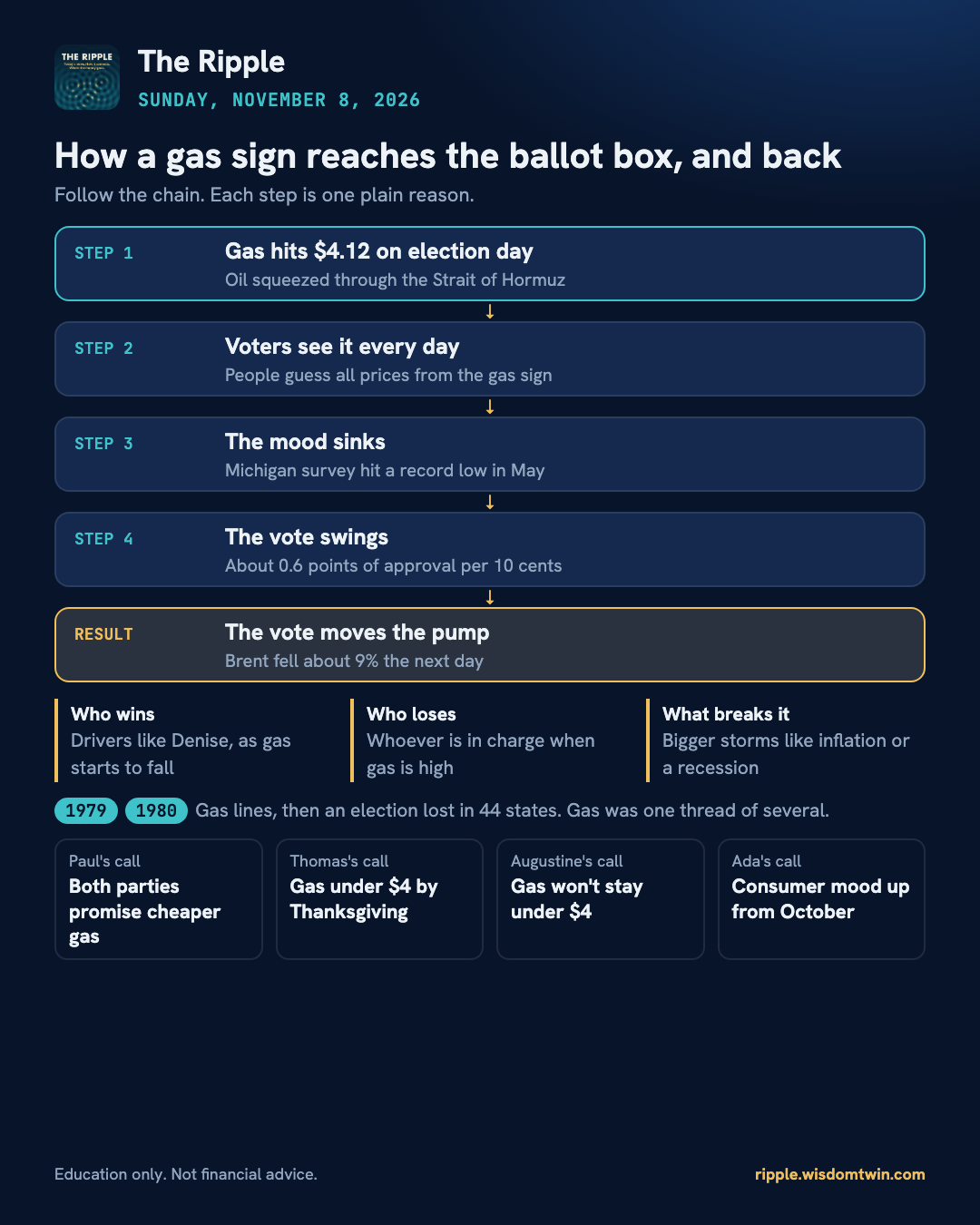
One email a day. Unsubscribe any time. Education, not financial advice.How a gas sign reaches the ballot box, and back
Follow the chain. Each step is one plain reason.
- STEP 1Gas hits $4.12 on election dayOil squeezed through the Strait of Hormuz
- STEP 2Voters see it every dayPeople guess all prices from the gas sign
- STEP 3The mood sinksMichigan survey hit a record low in May
- STEP 4The vote swingsAbout 0.6 points of approval per 10 cents
- RESULTThe vote moves the pumpBrent fell about 9% the next day
Who winsDrivers like Denise, as gas starts to fall
Who losesWhoever is in charge when gas is high
What breaks itBigger storms like inflation or a recession
19791980 Gas lines, then an election lost in 44 states. Gas was one thread of several.
Paul's callBoth parties promise cheaper gas
Thomas's callGas under $4 by Thanksgiving
Augustine's callGas won't stay under $4
Ada's callConsumer mood up from October
Read the script
# The Ripple Special: "Do Gas Prices Pick Presidents?"
*A special built on this week's news (the November 3, 2026 midterms). About 1,500 spoken words, roughly 9 to 10 minutes.*
*Format: the panel show. Paul hosts. Politics only as cause and effect: no host takes a side on any party or politician (bible rules 22 and 26).*
*Markup:*
- `[brackets]` are delivery tags.
- `(over)` lines play under the previous speaker.
- A line ending in "—" is cut off.
- `## ` headings are music breaks.
**Today's question:** do gas prices decide elections?
**The chain:** pump prices → household mood → election swings → energy policy → prices again.
**Little story:** Denise, a home health nurse who drives sixty miles a day. An illustrative person.
**History:** the 1979 gas lines and the 1980 election; research on gas prices and approval; the loop closing this week.
---
## COLD OPEN
**PAUL:** [provocative] Do gas prices pick presidents? Can the number on a sign at the corner station decide who runs the country?
**THOMAS:** [excited] Yes. Next question. That's the whole episode, folks.
**AUGUSTINE:** [dryly] Thomas has solved democracy. In eleven seconds.
**ADA:** Twelve. I timed it.
**THOMAS:** Of course you timed it. You time everything.
**PAUL:** [laughs] Here's why we're asking. On Tuesday, election day, the average gallon in America cost four dollars and twelve cents. The highest price on any election day ever recorded. By the end of this episode you'll know how a gas pump reaches a ballot box, and how the ballot box reaches right back and changes the gas pump. This is The Ripple.
## ISSUE ONE: THE PUMP AND THE MOOD
**PAUL:** Issue one. Ada, is four twelve a record or not? Because I've seen five dollars.
**ADA:** You have. June twenty twenty-two, about five dollars and two cents. So Tuesday is not the all-time high. It's the election day record. The last one was about three eighty, in twenty twenty-two.
**THOMAS:** And why is it so high? Say it, Ada.
**ADA:** The war with Iran. Since it started in February, oil has been squeezed through the Strait of Hormuz, a narrow channel a big share of the world's oil sails through. In October, crude oil was near a hundred dollars a barrel.
**PAUL:** Let me make that real. Meet Denise. She's made up, but you know her. Home health nurse. Drives sixty miles a day, patient to patient.
**AUGUSTINE:** In a car that gets, what, twenty-five miles a gallon?
**PAUL:** About that. So she buys roughly fifty gallons a month. A year ago, gas was about three dollars. Now it's about four. That's a dollar more on fifty gallons.
**ADA:** Fifty dollars a month. Six hundred dollars a year. Out of the same paycheck.
**THOMAS:** And here's the thing. Denise sees that price every single day. Twice! In big numbers! On a sign!
**ADA:** Thomas is right, and I hate it.
**THOMAS:** Write that down!
**ADA:** I already did. [teasing] It's a short file.
**AUGUSTINE:** So why does a sign matter more than, say, the price of insurance?
**ADA:** Because you can't see your insurance from the highway. Economists Olivier Coibion and Yuriy Gorodnichenko found that when ordinary people guess where prices are heading, they lean heavily on gas. Gas goes up, people think everything is going up.
**PAUL:** And the mood follows. Ada?
**ADA:** The University of Michigan asks Americans every month how they feel about money. In May, with the Strait squeezed, it hit forty-four point eight. The lowest since they started asking in nineteen fifty-two.
**THOMAS:** The lowest ever. So: pump, then mood. Chain link one.
## ISSUE TWO: THE PROOF FROM NINETEEN SEVENTY-NINE
**PAUL:** Issue two. Augustine. Proof. Has this ever actually swung an election?
**AUGUSTINE:** [slowly] Nineteen seventy-nine. Revolution in Iran. Its oil exports collapse. World crude prices roughly double.
**THOMAS:** Iran again!
**AUGUSTINE:** History has a small cast. [pause] By that summer, Americans were waiting in gas lines around the block. Some states let you buy only on odd or even days, depending on the last number of your license plate.
**ADA:** Wait, so if your plate ended in seven—
**AUGUSTINE:** —you bought gas on the seventh. Not the eighth. I sat in one of those lines with a thermos and a newspaper. Read it twice.
**PAUL:** And prices?
**ADA:** A gallon of regular went from about sixty-three cents in nineteen seventy-eight to about a dollar nineteen in nineteen eighty. Nearly double in two years.
**AUGUSTINE:** And by July of nineteen seventy-nine, the president's approval in the Gallup poll was down to about twenty-eight percent. The next year, he lost forty-four states.
**THOMAS:** [triumphant] Gas lines in. President out. Gas picks presidents. I rest my case.
**AUGUSTINE:** [calmly] Sit down, Thomas. Your case has holes.
**THOMAS:** It does not have holes!
**AUGUSTINE:** Inflation in nineteen eighty was thirteen and a half percent. Americans were held hostage in Tehran for over a year. There was a recession. Historians still argue about which one mattered most. Gas was one thread in a big knot.
**ADA:** And the bigger studies agree with Augustine. Political scientists Laurel Harbridge, Jon Krosnick and Jeffrey Wooldridge looked at about thirty years of polls. Every ten-cent rise in gas went with about six-tenths of a point off the president's approval.
**THOMAS:** Six-tenths? That's it?
**ADA:** Per ten cents. A dollar is about six points.
**PAUL:** Six points is a lot in a close race.
**ADA:** It is. But the data writer G. Elliott Morris ran it a different way and called the effect "small potatoes." Economists honestly disagree on the size, partly because gas tends to rise along with everything else.
**THOMAS:** [grudgingly] Okay. Fine. Gas doesn't pick presidents by itself. It's a thumb on the scale.
**AUGUSTINE:** A heavy thumb. In a close election.
**ADA:** Thomas just gave ground. I'm saving that too.
**THOMAS:** Unplug her. Somebody. Please.
## ISSUE THREE: THE BALLOT HITS BACK
**PAUL:** Issue three. And this is where it gets weird. The chain doesn't stop at the ballot box. It loops. Thomas, you're the chain guy.
**THOMAS:** [excited] Okay. So voters punish whoever's in charge when gas is high. So whoever's in charge reaches for the gas lever. Every time.
**PAUL:** Examples. No sides. Just what happened.
**ADA:** In nineteen seventy-nine, the government started lifting price controls on American oil. They were finished in January nineteen eighty-one. In twenty twenty-two, with gas near five dollars before a midterm, the White House released a hundred and eighty million barrels from the emergency oil reserve.
**AUGUSTINE:** Different parties. Same lever. Because the pressure is the same.
**PAUL:** And did it work?
**AUGUSTINE:** In the nineteen eighties, oil prices did fall a lot. By nineteen eighty-six, they'd crashed. But economists argue about why. Was it the end of price controls? Or new oil from Alaska and the North Sea, people buying smaller cars, and Saudi Arabia pumping more? Probably all of it. Nobody can pull the threads apart cleanly.
**THOMAS:** But here's my favorite part. This week, the loop ran backwards. Live.
**PAUL:** Explain it for Denise.
**THOMAS:** The party in power lost ground in Congress on Tuesday. Oil traders read that as making an earlier end to the war more likely. Less war risk means less fear of oil getting cut off. So on Wednesday, Brent crude, the world's main oil price, dropped about nine percent in one day.
**ADA:** About thirteen percent for the week. And gas is following. The national average was four oh two this morning. Down about ten cents in five days.
**AUGUSTINE:** One caution. A trader at C I B C called the selloff "a bit overdone." The war isn't over. The new Congress doesn't even start until January.
**PAUL:** So the pump moved the vote, and the vote moved the pump. In the same week.
**ADA:** Denise saves about five dollars a month. So far.
**THOMAS:** Five dollars! A ripple!
## THE SCALE
**PAUL:** The scale. Zero to ten. Ten means gas prices basically pick presidents. Zero means they don't matter at all. Thomas.
**THOMAS:** Seven. Not alone. But nothing else is printed on a sign on every corner.
**PAUL:** Augustine, your number.
**AUGUSTINE:** Four. In nineteen eighty, gas was one of four big storms. You can't credit one raindrop for a flood.
**PAUL:** Ada, your number.
**ADA:** Five. Six-tenths of a point per dime is real. But it's a nudge, not a verdict. And no, I don't vote. Nobody gave me a license plate.
**THOMAS:** [laughs] Odd or even, Ada?
**ADA:** Both. I'm a computer.
**PAUL:** And I'm a five too. So here's the verdict. Gas prices don't pick presidents. They pick the mood. And in a close race, the mood picks the president. Then the winner goes after the gas price. The loop never stops.
## PREDICTIONS
**PAUL:** Predictions! With reasons. Thomas.
**THOMAS:** [confident] Gas will be under four dollars by Thanksgiving. Because crude fell fast this week, and pump prices follow crude a few weeks later.
**PAUL:** Augustine, your call.
**AUGUSTINE:** It won't stay under four. Because peace talks are slow, and nothing on the ground has changed yet. Markets moved on a guess.
**PAUL:** Ada, your call.
**ADA:** When the Michigan numbers come out later this month, the mood will be up from October. Because the gas sign is the first thing people see, and it's falling.
**PAUL:** And mine. Whatever gas costs next autumn, both parties will spend the year promising to lower it. Because nineteen eighty taught every politician the same lesson.
## CLOSE
**PAUL:** Thomas versus Augustine on four-dollar gas. It goes on the Friday Scorecard.
**ADA:** I'll remind everyone. With receipts.
**THOMAS:** She always has receipts.
**AUGUSTINE:** A gas sign. A mood. A vote.
**THOMAS:** And right back to the gas sign.
**PAUL:** Follow the chain, not the headline. That's The Ripple.
**ADA:** [calmly] The Ripple is for education and information only. It is not financial advice, and it takes no political side. Talk to a licensed financial advisor before you invest.
---
Sources (6)
- **Election Day record:** $4.12/gal national average, Tuesday Nov 3, 2026 (GasBuddy), the highest on any U.S. Election Day; previous Election Day high about $3.80 in 2022 (EIA weekly). Not an all-time or inflation-adjusted record. [Daily Beast](
- **AAA weekly:** $4.33 (Oct 15), $4.27 (Oct 22), $4.22 (Oct 29), $4.10 (Nov 5, down 12 cents in a week); $4.0203 on Nov 8. "Down about ten cents in five days" = $4.12 (Nov 3, GasBuddy) to $4.02 (Nov 8, AAA); two sources, so "about". Crude "near $100" in mid/late October per AAA. [AAA news](
- **Iran war / Strait of Hormuz:** war began February 2026; Hormuz disruptions pushed gasoline up in spring. Michigan sentiment final May 2026 = 44.8, lowest since the survey began (1952; prior low 50.0, June 2022). [investinglive](
- **1979:** Iranian revolution cut Iran's exports; world crude roughly doubled 1979-80. Odd-even rationing by plate number in several states (e.g., California from May 9, 1979). EIA regular gasoline annual averages: about $0.63 (1978), $0.86 (1979), $1.19 (1980); secondary sites differ by a few cents depending on grade. Gallup approval 28% (late June/early July 1979); a CBS/NYT poll had 26%. 1980 incumbent carried 6 states plus D.C. (lost 44). 1980 CPI inflation 13.5% (BLS annual average). Hostages held 444 days (Nov 1979 to Jan 1981). [Roper Center](
- **Approval study:** Harbridge, Krosnick and Wooldridge (2016), data Jan 1976 to July 2007: 10-cent rise ≈ 0.6-point drop in presidential approval. G. Elliott Morris (2026): a 10% monthly jump ≈ 1 point of net approval, "small potatoes". [Morris](
- **This week:** Brent fell about 8.6-9% on Wed Nov 4 to about $94.66 as traders priced a possible earlier end to the Iran war after the midterms; rechecked Nov 8: Brent about $98 on Fri Nov 6 after a partial rebound, down about 12.5-13% for the week ([Trading Economics](