
The RippleToday's news. How it connects. Where the money goes.
Sun Nov 8 · 8 min
Is Cheap Oil India's Secret Weapon?
India's main stock index had its best week since 2021 as oil fell. The panel follows the chain from a barrel of oil to the rupee and Indian banks, and looks back at 1991.
0:00 / 8:25
Listen on Spotify
Get it every morning
The new episode and its infographic in your inbox before the market opens. Free.
One email a day. Unsubscribe any time. Education, not financial advice.How cheaper oil lifted India's markets
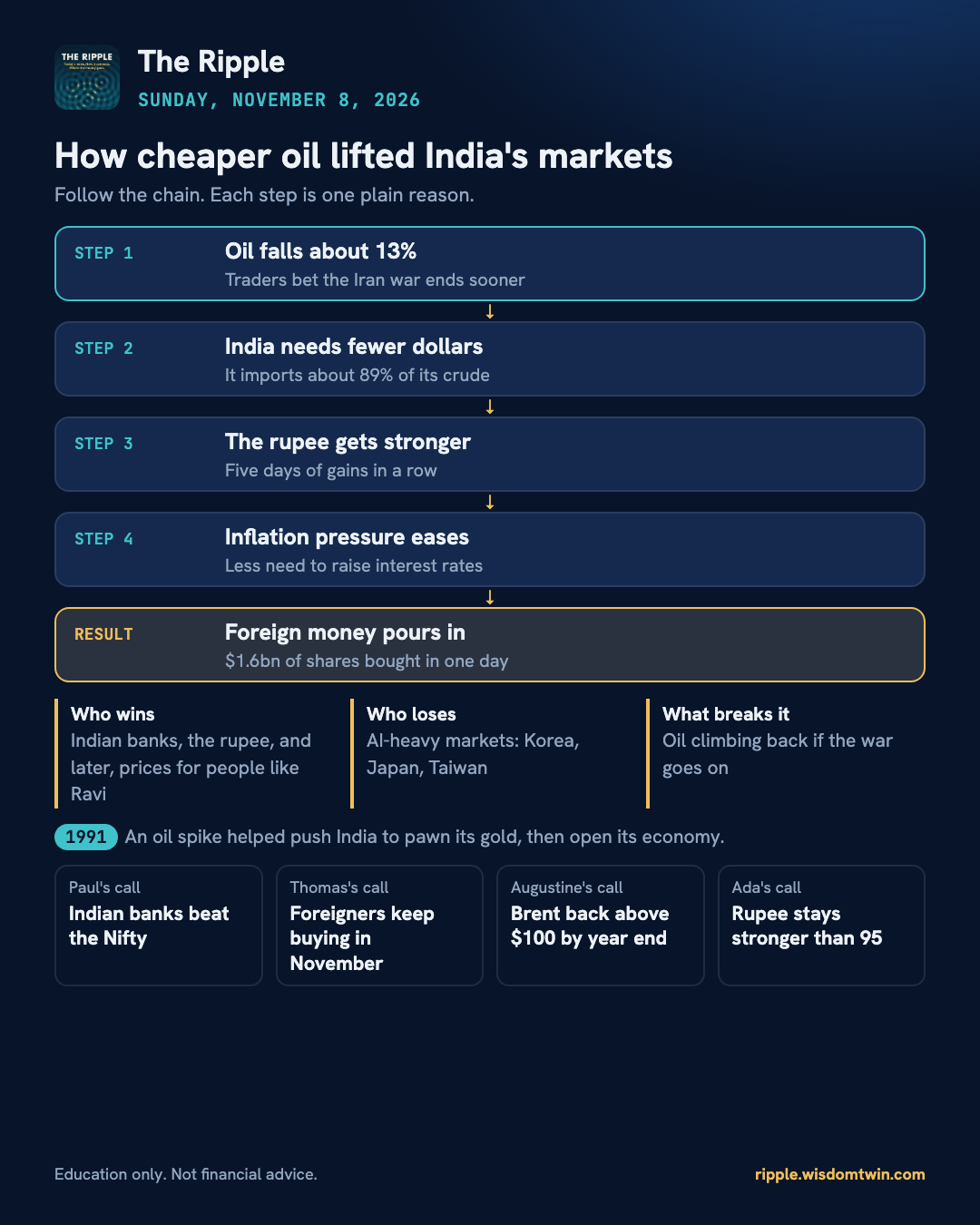
Follow the chain. Each step is one plain reason.
- STEP 1Oil falls about 13%Traders bet the Iran war ends sooner
- STEP 2India needs fewer dollarsIt imports about 89% of its crude
- STEP 3The rupee gets strongerFive days of gains in a row
- STEP 4Inflation pressure easesLess need to raise interest rates
- RESULTForeign money pours in$1.6bn of shares bought in one day
Who winsIndian banks, the rupee, and later, prices for people like Ravi
Who losesAI-heavy markets: Korea, Japan, Taiwan
What breaks itOil climbing back if the war goes on
1991 An oil spike helped push India to pawn its gold, then open its economy.
Paul's callIndian banks beat the Nifty
Thomas's callForeigners keep buying in November
Augustine's callBrent back above $100 by year end
Ada's callRupee stays stronger than 95
Read the script
# The Ripple Special: "Is Cheap Oil India's Secret Weapon?"
*A special built on this week's news (week ending Friday, November 6, 2026). About 1,500 spoken words, roughly 9 to 10 minutes.*
*Format: the panel show. Paul hosts. Politics only as cause and effect: no host takes a side on any party or politician (bible rules 22 and 26).*
*Markup:*
- `[brackets]` are delivery tags.
- `(over)` lines play under the previous speaker.
- A line ending in "—" is cut off.
- `## ` headings are music breaks.
**Today's question:** is cheap oil India's secret weapon, or just its oldest weakness taking a day off?
**The chain:** lower oil → smaller import bill → stronger rupee → lower inflation → foreign money flows in.
**Little story:** Ravi, who runs three delivery scooters in Pune. An illustrative person.
**History:** the 1991 balance-of-payments crisis, set off by the Gulf War oil spike, which forced India to open up.
---
## COLD OPEN
**PAUL:** [provocative] Is cheap oil India's secret weapon? Can a vote in America and a barrel of oil from the Gulf make Indian bank stocks jump ten percent in a week?
**THOMAS:** [excited] They did! That actually happened! I watched it!
**AUGUSTINE:** [dryly] Thomas watched it. Thomas watches everything. He hasn't blinked since Tuesday.
**ADA:** I haven't blinked since I was installed.
**THOMAS:** That's because you don't have eyes, Ada.
**ADA:** I have cameras. Several. Mostly pointed at your portfolio.
**PAUL:** [laughs] Here's the news. While AI-heavy markets in Asia got hammered this week, India's Nifty fifty, its main stock index, had its best week since February twenty twenty-one. By the end you'll know why a cheaper barrel of oil is worth billions to India, and why, back in nineteen ninety-one, an expensive one nearly broke it. This is The Ripple.
## ISSUE ONE: THE WEEK
**PAUL:** Issue one. Ada, the numbers.
**ADA:** The Nifty rose eight point six percent in the week to Friday. It closed at about twenty-five thousand. Every one of its sixteen main sectors went up. Banks rose about ten percent. H D F C Bank, almost fourteen.
**THOMAS:** And meanwhile, on Friday. Seoul?
**ADA:** South Korea's Kospi fell six percent. Japan's Nikkei, six percent. Taiwan, four and a half.
**AUGUSTINE:** Those are the markets full of chip makers. The companies building the AI boom.
**THOMAS:** Right. So the money ran out of the AI trade and went looking for somewhere with almost no AI exposure. India! Hiding in plain sight!
**PAUL:** And the oil part?
**ADA:** After the U.S. midterms on Tuesday, traders bet the war with Iran might end sooner. Brent crude, the world's main oil price, fell about thirteen percent in the week. Down to just under a hundred dollars a barrel.
**PAUL:** So a vote in Ohio moves a bank in Mumbai.
**THOMAS:** Through a barrel of oil. That's the ripple, baby!
**AUGUSTINE:** Please never say "baby" on this show again.
## ISSUE TWO: THE CHAIN
**PAUL:** Issue two. Walk it for a normal person. Thomas, link one.
**THOMAS:** India buys almost all its oil from abroad. Ada?
**ADA:** About eighty-nine percent of its crude is imported. Nearly nine barrels in every ten.
**PAUL:** And it pays in?
**ADA:** Dollars. Oil is priced in dollars. So India has to sell rupees to buy dollars to buy oil.
**THOMAS:** So when oil gets cheaper, India needs fewer dollars. Fewer people selling rupees. The rupee gets stronger.
**ADA:** It did this week. About ninety-four point three five to the dollar by Thursday. Five days of gains in a row.
**AUGUSTINE:** And how big is the saving? In actual money?
**ADA:** The Reserve Bank of India has a rule of thumb. Every ten dollars cheaper on a barrel saves the country about twelve and a half billion dollars a year.
**THOMAS:** And this week it dropped about fifteen dollars!
**ADA:** So close to twenty billion dollars a year. If it lasts. And it's a rough rule from twenty nineteen, so don't hold me to the decimal.
**THOMAS:** You? Not hold to a decimal? Who are you?
**ADA:** A humble machine. Unlike some.
**PAUL:** Now make it human. Ravi. He's made up, but he's real enough. Runs three delivery scooters in Pune.
**AUGUSTINE:** Does Ravi see the price drop at the pump?
**ADA:** Not right away. In India, state-run oil companies often keep pump prices steady. So cheap oil shows up first in their accounts and the government's budget. Ravi feels it later. Cheaper trucking. Cheaper groceries. Less inflation.
**PAUL:** And inflation's the next link?
**ADA:** The same Reserve Bank study found ten dollars a barrel adds about half a point to India's inflation. Newer estimates say a bit less. So cheaper oil takes some of that back off.
**THOMAS:** And lower inflation means the central bank doesn't have to raise interest rates. Which helps banks. Which is why bank stocks jumped the most!
**PAUL:** Last link. The foreigners.
**ADA:** On Thursday, foreign investors bought about one point six billion dollars of Indian shares. In one day. Their biggest day in nearly six years.
**THOMAS:** Because a steady rupee means a foreigner's gains don't get eaten when they change the money back. Cheap oil, strong rupee, low inflation, money pours in. A secret weapon!
**AUGUSTINE:** [calmly] Or a weakness. Taking a day off.
## ISSUE THREE: NINETEEN NINETY-ONE
**PAUL:** Issue three. Augustine. You've been waiting all episode.
**AUGUSTINE:** I've been waiting thirty-five years. [pause] August nineteen ninety. Iraq invades Kuwait. Oil goes from under twenty dollars a barrel to around forty in a few months.
**THOMAS:** So the same chain. In reverse.
**AUGUSTINE:** Exactly in reverse. India needs far more dollars to buy the same oil. And worse: over a hundred thousand Indian workers had to be flown out of Kuwait.
**ADA:** One of the largest civilian airlifts in history.
**AUGUSTINE:** And those workers had been sending money home. In dollars. So dollars coming in fall, while dollars going out rise.
**PAUL:** How bad did it get?
**ADA:** By early nineteen ninety-one, India's foreign money reserves were down to about one point two billion dollars. Barely enough to pay for three weeks of imports.
**THOMAS:** Three weeks. For a country of eight hundred and fifty million people?
**AUGUSTINE:** And then the famous part. In the spring and summer of nineteen ninety-one, India flew its gold abroad. About forty-seven tonnes to the Bank of England. Twenty more to a Swiss bank. As collateral for emergency loans.
**THOMAS:** [quietly] They pawned the gold.
**AUGUSTINE:** They pawned the gold. Then in July, the rupee was cut about eighteen percent in two steps. And on July twenty-fourth, a new finance minister, Manmohan Singh, gave a budget that started opening the economy. Fewer licenses. More foreign investment allowed.
**ADA:** But fair warning. Oil was the spark, not the whole fire. Economists point to years of government deficits, a lot of foreign borrowing, political turmoil, and the collapse of the Soviet Union, which had been a huge trading partner. People still argue about how much was oil.
**AUGUSTINE:** True. But a spark is what lights it. India learned it can't control the price of the thing it buys most.
**THOMAS:** So you're saying cheap oil isn't a weapon.
**AUGUSTINE:** I'm saying it's the absence of a punch. Nice. But not something India owns.
**THOMAS:** [grudgingly] Okay. That's a good line. I hate that it's a good line.
**ADA:** Saved. Next to the other time.
**THOMAS:** There was one other time. One!
## THE SCALE
**PAUL:** The scale. Zero to ten. Ten means this Indian rally lasts all year. Zero means it fades by Christmas. Thomas.
**THOMAS:** Eight. Foreign money has ignored India all year. The Nifty's still down for the year. There's lots of room to come back.
**PAUL:** Augustine, your number.
**AUGUSTINE:** Four. The rally rests on a guess about a war. Guesses change. Oil can climb back in a week.
**PAUL:** Ada, your number.
**ADA:** Six. Banks and the rupee are real wins. But fast money leaves as fast as it comes. In nineteen ninety-one, foreigners pulled their deposits right when India needed them most.
**PAUL:** And I'm a five. So the verdict. Cheap oil isn't India's secret weapon. It's India's oldest weakness, taking a day off. Enjoy the day. But watch the oil price, because India still doesn't control it.
## PREDICTIONS
**PAUL:** Predictions! With reasons. Thomas.
**THOMAS:** [confident] Foreign investors keep buying India through the end of November. Because the AI selloff isn't done, and India is the big market least tied to it.
**PAUL:** Augustine, your call.
**AUGUSTINE:** Brent is back above a hundred dollars before the end of the year. Because the war hasn't ended. Traders just hope it will.
**PAUL:** Ada, your call.
**ADA:** The rupee stays stronger than ninety-five to the dollar through November. Because cheaper oil means fewer dollars needed, every single day.
**PAUL:** And mine. Indian banks beat the Nifty over the next three months. Because they gain twice: from lower inflation, and from the foreign money that buys them first.
## CLOSE
**PAUL:** Thomas versus Augustine on oil and foreign money. Friday Scorecard.
**ADA:** Logged. Time-stamped. Backed up three times.
**THOMAS:** She has backups of her backups.
**AUGUSTINE:** A vote in America. A barrel from the Gulf.
**THOMAS:** And a bank in Mumbai.
**PAUL:** Follow the chain, not the headline. That's The Ripple.
**ADA:** [calmly] The Ripple is for education and information only. It is not financial advice, and it takes no political side. Talk to a licensed financial advisor before you invest.
---
Sources (6)
- **The week:** Nifty 50 closed at 25,030.35 on Fri Nov 6, 2026, up 8.6% for the week; Sensex 81,028.02, up 8.8%. Strongest weekly gains since February 2021 (some outlets say January 2021; script uses Reuters' February). All 16 major sectors up; financials +10.4%; HDFC Bank +13.8% ("almost fourteen"); ICICI +12.4%. The opener's "bank stocks jump ten percent" = financials +10.4% (rechecked Nov 8; was "thirteen"). Year-to-date Nifty still -4.2%. [Business Recorder / Reuters](
- **Oil:** Brent fell about 8.6% on Wed Nov 4 to about $94.66 on bets of an earlier end to the Iran war after the U.S. midterms; Rechecked Nov 8: Brent about $98.3 on Fri Nov 6 after a partial rebound, down about 12.5-13% for the week (Trading Economics); the $90.8 ticker figure was WTI-range, not Brent. Said on air: "about thirteen percent", "just under a hundred dollars". "About fifteen dollars": from roughly $113 (Oct 30) to roughly $98. [Trading Economics Brent](
- **Rupee:** opened 94.35/$ on Thu Nov 5 vs 94.64 prior close, fifth straight session of gains. [FXStreet](
- **Import dependence:** PPAC: 88.7% (FY26), about 89.1% in Q1 FY27. Said "about eighty-nine percent". [Angel One on PPAC data](
- **Rule of thumb:** RBI economists' 2019 study: each $10/bbl rise adds about $12.5 billion to the deficit (about 0.43% of GDP) and about 0.49 percentage points to headline inflation (at a $65 base). Newer estimates: SBI Research 35-40 bps of inflation; ICRA about 0.3% of GDP on the current account. "Close to twenty billion" = $15 x $1.25bn per dollar, if sustained; flagged on air as rough. [Business Standard](
- **1991:** Iraq invaded Kuwait Aug 2, 1990; oil rose from under $20 (about $17 in July 1990) to around $40 by October 1990. India evacuated about 110,000 citizens from Kuwait by air (Aug-Oct 1990), cutting Gulf remittances. Reserves about $1.2 billion in January 1991, about three weeks of imports. Gold: about 47 tonnes to the Bank of England and 20 tonnes to UBS, for about $600 million (flights in May 1991; the RBI's history also records a July 1991 pledge of 46.91 tonnes with the Bank of England and Bank of Japan), so the script says "spring and summer". Rupee devalued about 18-19% in two steps on July 1 and 3, 1991. Budget of July 24, 1991 by Finance Minister Manmohan Singh: delicensing, up to 51% foreign equity in priority industries. Other causes (disputed weighting): fiscal deficits near 10% of GDP, external debt rising to $64 billion, political instability, Moody's downgrade, collapse of Soviet trade, withdrawal of non-resident Indian deposits. India population 1991 census: about 846 million ("eight hundred and fifty million" on air). [1991 Indian economic crisis](