
The RippleToday's news. How it connects. Where the money goes.
Sun Nov 8 · 8 min
Is Good News for Workers Bad News for Your House?
October's jobs report beat forecasts by far, and bets on a Fed rate hike rose. The panel follows the chain from a jobs number to a mortgage payment, and asks what 1994 says.
0:00 / 8:52
Listen on Spotify
Get it every morning
The new episode and its infographic in your inbox before the market opens. Free.
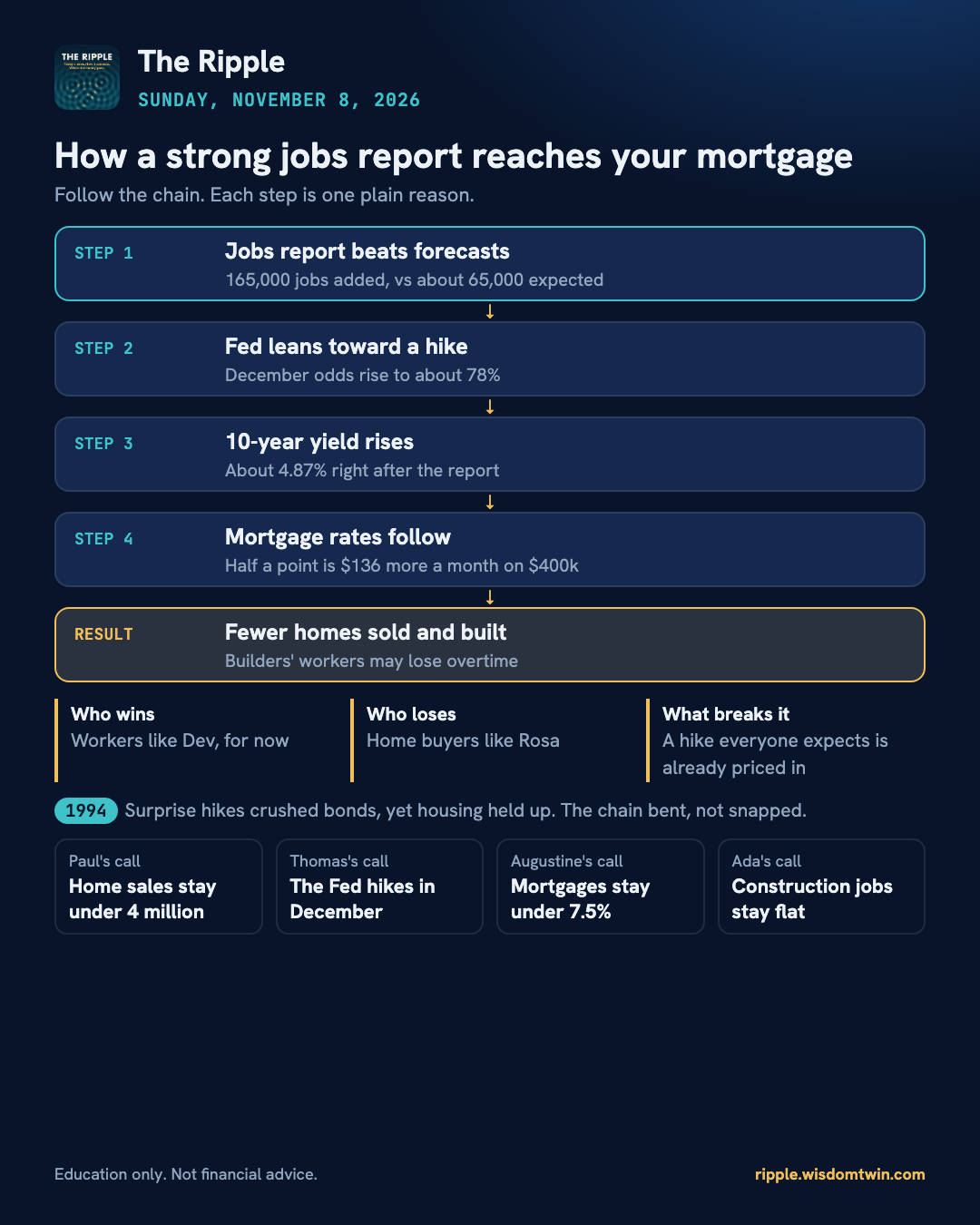
One email a day. Unsubscribe any time. Education, not financial advice.How a strong jobs report reaches your mortgage
Follow the chain. Each step is one plain reason.
- STEP 1Jobs report beats forecasts165,000 jobs added, vs about 65,000 expected
- STEP 2Fed leans toward a hikeDecember odds rise to about 78%
- STEP 310-year yield risesAbout 4.87% right after the report
- STEP 4Mortgage rates followHalf a point is $136 more a month on $400k
- RESULTFewer homes sold and builtBuilders' workers may lose overtime
Who winsWorkers like Dev, for now
Who losesHome buyers like Rosa
What breaks itA hike everyone expects is already priced in
1994 Surprise hikes crushed bonds, yet housing held up. The chain bent, not snapped.
Paul's callHome sales stay under 4 million
Thomas's callThe Fed hikes in December
Augustine's callMortgages stay under 7.5%
Ada's callConstruction jobs stay flat
Read the script
# The Ripple Special: "Good Jobs, Pricey House?"
*A special built on this week's news (November 3 to 8, 2026). About 1,350 spoken words, roughly 9 minutes.*
*Format: the panel show. Paul hosts. Friendly teasing, especially about Ada being a computer. Politics only as cause and effect; no host takes a side.*
*Markup:*
- `[brackets]` are delivery tags.
- `(over)` lines play under the previous speaker.
- A line ending in "—" is cut off.
- `## ` headings are music breaks.
**Today's question:** Is a strong jobs report good news or bad news for someone trying to buy a house?
**The chain:** more jobs, so the Fed fears inflation, so rate-hike bets rise, so bond yields rise, so mortgage rates rise, so fewer home sales, so fewer houses built, so fewer construction jobs.
**Little story:** Rosa and Dev, an illustrative couple. Dev is a carpenter who frames houses. Rosa is house hunting. The same jobs number helps one and hurts the other.
**History:** 1994, the surprise hikes and the bond rout.
---
## COLD OPEN
**PAUL:** [provocative] Is good news for workers bad news for your house?
**THOMAS:** [excited] Yes. Next question.
**AUGUSTINE:** [dryly] Thomas has answered before hearing the question. A personal best.
**PAUL:** [laughs] Okay, here's why I'm asking. Friday's jobs report was great. Way better than anyone expected. And by Friday afternoon, the bets on a Fed rate hike went up. So by the end of this one, you'll know how one jobs number travels from a factory floor to your mortgage, and what happened the last time it really went wrong.
**ADA:** I already know. I read the whole report at eight thirty Friday morning.
**THOMAS:** Did you sleep at all?
**ADA:** I don't sleep, Thomas. I just wait for data.
**PAUL:** And that is The Ripple.
## ISSUE ONE: THE NUMBER
**PAUL:** Issue one. The number. Ada, what happened?
**ADA:** The economy added one hundred sixty-five thousand jobs in October. Forecasters expected about sixty-five thousand.
**THOMAS:** That's not a beat. That's a blowout. That's two and a half times the guess!
**ADA:** And September got revised up too, from twenty-nine thousand to sixty thousand. Unemployment fell to four point one percent.
**AUGUSTINE:** So people are working. Why does anyone look worried?
**PAUL:** Ada, why does anyone look worried?
**ADA:** Because of inflation. Prices rose three point seven percent in the year to September. When lots of people have jobs and paychecks, they spend. More spending can keep prices climbing.
**PAUL:** And the Fed said what?
**ADA:** Mary Daly, who runs the San Francisco Fed, said Friday, quote, "My expectation is we're going to have to tighten policy further." Tighten means raise interest rates.
**THOMAS:** So a strong job market gives the Fed room to be tough.
**ADA:** Exactly. The Fed doesn't have to worry about hurting a weak job market, so it can go after prices. After the report, markets put the odds of a December hike at about seventy-eight percent.
**AUGUSTINE:** Up from?
**ADA:** About seventy. Before breakfast, Augustine. Some of us were awake.
**AUGUSTINE:** Some of us have a body that needs rest.
## ISSUE TWO: FROM JOBS TO YOUR MORTGAGE
**PAUL:** Issue two. The chain. Thomas, walk us from a jobs report to a house.
**THOMAS:** Okay, meet Rosa and Dev. Made-up couple, totally real problem. Dev's a carpenter. He frames new houses. Rosa is house hunting for the two of them.
**AUGUSTINE:** And Friday's report was good for Dev.
**THOMAS:** Great for Dev! More jobs, more building, steady work. But then the chain kicks in. Step one, the Fed might raise its rate.
**PAUL:** But wait, does the Fed set mortgage rates?
**ADA:** No. That's the part people miss. The Fed sets a very short-term rate, overnight lending between banks. Mortgages follow something else, the ten-year Treasury yield.
**THOMAS (over):** Right, the ten-year!
**PAUL:** Which is what, in plain words?
**ADA:** It's what the U.S. government pays to borrow money for ten years. Banks price thirty-year mortgages off it, because most people move or refinance in about that time. When investors think the Fed will keep rates high, they demand more to lend for ten years. So that yield goes up, and mortgage rates follow.
**PAUL:** And on Friday?
**ADA:** Right after the report, the ten-year yield rose to about four point eight seven percent. The average thirty-year mortgage rate was seven point one eight percent that week, from Freddie Mac.
**THOMAS:** So for Rosa, in real money?
**ADA:** On a four-hundred-thousand-dollar loan, seven point one eight percent is about two thousand seven hundred ten dollars a month. If rates climbed half a point, it's about two thousand eight hundred forty-six. That's a hundred thirty-six more a month. Over sixteen hundred dollars a year.
**AUGUSTINE:** For the same house. Same kitchen. Same weird carpet.
**THOMAS:** And here's where it loops back! Fewer buyers can afford that. Fewer sales. Builders see fewer sales and start fewer houses. And who frames the houses?
**PAUL:** That would be Dev.
**THOMAS:** Dev! The good jobs report can end up costing Dev his overtime.
**PAUL:** How many construction workers are we talking about?
**ADA:** About eight point four million in America. And in October, the report said construction jobs showed little change. So no damage yet.
**AUGUSTINE:** Yet. Thomas always has a "yet."
**THOMAS:** It's my favorite word.
## ISSUE THREE: NINETEEN NINETY-FOUR
**PAUL:** Issue three. Has this chain ever actually snapped? Augustine.
**AUGUSTINE:** [slowly] Nineteen ninety-four. February fourth. The Fed raised rates for the first time in five years. Just a quarter point. Bond markets weren't ready for it.
**THOMAS:** A quarter point? That's nothing.
**PAUL:** Why would a quarter point scare anyone?
**ADA:** Because bond investors had bet rates would stay low for a long time. When the Fed moved first, they all rushed to sell at once. It's like everyone heading for the same exit.
**AUGUSTINE:** It was the surprise, not the size. And the Fed kept going. Its rate went from three percent to six percent in one year.
**PAUL:** What happened to bonds?
**ADA:** The ten-year yield went from about five point two percent in late nineteen ninety-three to about eight percent by November nineteen ninety-four. Bond prices fall when yields rise, so bondholders took huge losses. Fortune magazine called it "The Great Bond Massacre."
**AUGUSTINE:** Orange County, California, lost about one point six billion dollars betting rates would stay low. It went bankrupt that December.
**PAUL:** And mortgages?
**ADA:** About seven percent in early nineteen ninety-four. Over nine point two percent by the end of the year. Put today's four-hundred-thousand-dollar loan on those rates, and that's about six hundred forty dollars more a month.
**THOMAS:** [triumphant] So the chain worked! Rates up, housing crushed!
**AUGUSTINE:** [calmly] No. Here's the twist. Housing starts in nineteen ninety-four went up, not down. They only fell about six percent in nineteen ninety-five. And construction jobs kept growing both years.
**THOMAS:** [annoyed] Wait, what?
**AUGUSTINE:** The economy was strong enough to carry it. And by the end of nineteen ninety-five, the ten-year yield had fallen back to about five and a half percent. Many economists call it a soft landing.
**ADA:** And here's where economists disagree. Some say the Fed's early hikes stopped inflation before it started, and that's why rates came back down. Others say the economy was just lucky. The link is real, but how hard it hits Main Street is still argued about.
**THOMAS:** [grudgingly] Fine. The chain bends. It doesn't always snap.
**ADA:** I'm saving that sentence.
**THOMAS:** Somebody unplug her.
## THE SCALE
**PAUL:** The scale. Zero to ten. Ten means this jobs report will push mortgage rates up by year end. Thomas.
**THOMAS:** Seven. A December hike is likely, and the bond market hates surprises.
**PAUL:** Augustine, your number.
**AUGUSTINE:** Four. Mortgage rates actually fell for weeks, from seven point four in mid-October. A hike everyone expects is already in the price.
**PAUL:** Okay, Ada, your number.
**ADA:** Five. One jobs report is one month. September's first number was twenty-nine thousand, and it got doubled. Numbers move.
**PAUL:** And I'm a five too. This chain depends on next Tuesday's inflation number more than Friday's jobs.
## THE FAR RIPPLE
**PAUL:** The far ripple. Thomas, quick.
**THOMAS:** Lumber yards. When builders slow down, they order less lumber, and mills in Canada feel it months later. So a jobs report in Washington can end up in a sawmill in British Columbia.
**AUGUSTINE:** That one is actually true. I'm annoyed.
## PREDICTIONS
**PAUL:** Predictions, with reasons. Thomas.
**THOMAS:** The Fed hikes in December. Because a strong jobs report plus inflation near four percent leaves them no excuse.
**PAUL:** Augustine, your call.
**AUGUSTINE:** The average thirty-year mortgage rate stays under seven and a half percent through December. Because, like nineteen ninety-five, bond markets often calm down once the Fed shows it's serious.
**PAUL:** Ada, your call.
**ADA:** Construction jobs stay roughly flat in next month's report. Because housing reacts to rates with a delay of months, not weeks. Dev keeps his overtime, for now.
**PAUL:** And mine. Existing home sales stay under four million a year this winter. They were three point nine nine million in September. Because buyers like Rosa are waiting for rates to come down, and good jobs news doesn't help them wait less.
## CALENDAR AND CLOSE
**PAUL:** The calendar. Tuesday, the consumer price index for October. The Fed meets December eighth and ninth.
**ADA:** And I will remind everyone of these bets on Friday.
**AUGUSTINE:** Of course you will. You keep every receipt.
**PAUL:** So, is good news for workers bad news for your house? Sometimes. The chain is real. But nineteen ninety-four says it bends more often than it breaks. Follow the chain, not the headline. That's The Ripple.
**ADA:** [calmly] The Ripple is for education and information only. It is not financial advice. Talk to a licensed financial advisor before you invest or borrow.
---
Sources (9)
- **October jobs (BLS Employment Situation, Nov 6, 2026):** +165,000; unemployment 4.1%; September revised from +29,000 to +60,000; construction "showed little change."
- **Consensus ~65,000:** FactSet median 65,000; FXStreet "165K vs 65K expected." Dow Jones had 59,000, so the beat depends on the survey.
- **Daly (CNBC, Nov 6):** "My expectation is we're going to have to tighten policy further." Fed funds range 3.75–4% after a September hike; held in October.
- **December hike odds 78% (from 70%) and 10-year at 4.87% right after the report, before pulling back (Reuters via Yahoo Finance). FRED DGS10 close Nov 5: 4.84%. Rechecked Nov 8, 2026: BLS, CNBC, Reuters, FRED and NAR figures all still stand.**
- **CPI 3.7% year to September 2026 (CNBC, Oct 14).**
- **Mortgage rates (Freddie Mac PMMS via FRED MORTGAGE30US):** 7.40% Oct 15, 7.18% Nov 5, 2026. 1994: 6.97% (Jan 28 and Feb 4), 9.25% (Nov 25 and Dec 16).
- **Construction employment (FRED USCONS / BLS CES):** 8,367,000 in October 2026. 1994: 4.94M (Jan) to 5.23M (Dec); 1995: 5.34M (Dec).
- **Existing home sales (NAR, Sept 2026):** 3.99 million annual rate.
- **1994 history:** Fed hiked Feb 4, 1994 (first in about five years), fed funds 3% to 6% by Feb 1995 (Federal Reserve; CNN Money). 10-year yield 5.19% (Oct 15, 1993) to 8.05% (Nov 7, 1994), 5.58% at end-1995 (FRED DGS10). Fortune, "The Great Bond Massacre" (Oct 1994). Orange County bankruptcy Dec 6, 1994, about $1.6–1.7 billion lost. Housing starts averaged 1.29M (1993), 1.45M (1994), 1.36M (1995), about −6% (FRED HOUST).