
The RippleToday's news. How it connects. Where the money goes.
Sun Nov 8 · 11 min
Can a Vote in Ohio Sink Taiwan's Economy?
After the midterms, towns voted against new data centers and Asia's chip stocks fell hard. The panel follows the chain from a field in Ohio to Taipei, and asks what history says.
0:00 / 11:22
Listen on Spotify
Get it every morning
The new episode and its infographic in your inbox before the market opens. Free.
One email a day. Unsubscribe any time. Education, not financial advice.How a vote in Ohio shook Taiwan's economy
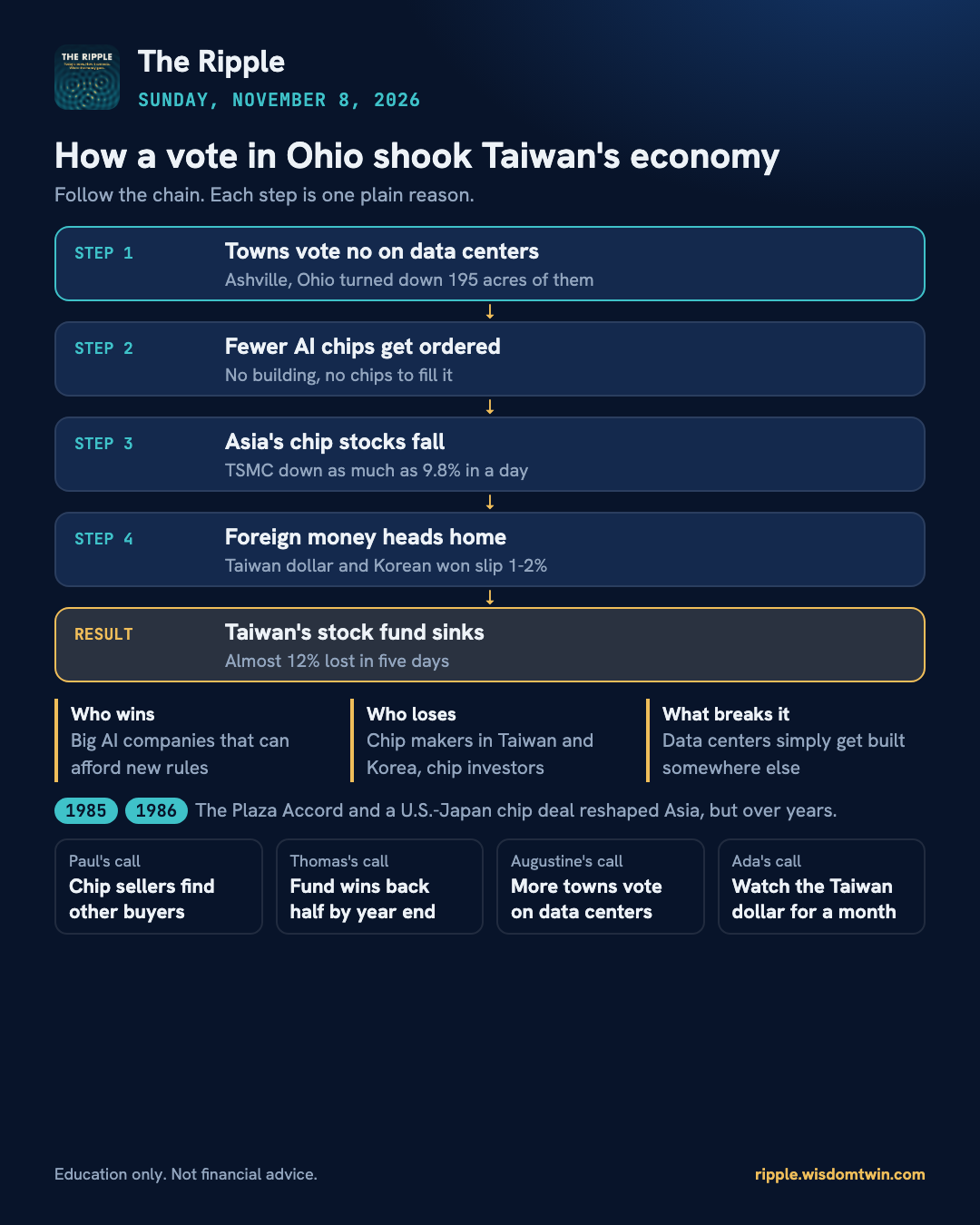
Follow the chain. Each step is one plain reason.
- STEP 1Towns vote no on data centersAshville, Ohio turned down 195 acres of them
- STEP 2Fewer AI chips get orderedNo building, no chips to fill it
- STEP 3Asia's chip stocks fallTSMC down as much as 9.8% in a day
- STEP 4Foreign money heads homeTaiwan dollar and Korean won slip 1-2%
- RESULTTaiwan's stock fund sinksAlmost 12% lost in five days
Who winsBig AI companies that can afford new rules
Who losesChip makers in Taiwan and Korea, chip investors
What breaks itData centers simply get built somewhere else
19851986 The Plaza Accord and a U.S.-Japan chip deal reshaped Asia, but over years.
Paul's callChip sellers find other buyers
Thomas's callFund wins back half by year end
Augustine's callMore towns vote on data centers
Ada's callWatch the Taiwan dollar for a month
Read the script
# The Ripple Special: "Can a Vote in Ohio Sink Taiwan's Economy?"
*Special, news-hooked. Data as of the close on Friday, November 6, 2026. About 1,500 words, roughly 9 to 10 minutes.*
*Format: the panel show. Paul hosts. Politics only as cause and effect: no host takes a side on any party or politician (bible rules 22, 26).*
**Today's question:** can one American vote really sink an economy on the other side of the world?
**Little story:** Ashville, Ohio, a small town that voted down a data center on a hundred and ninety-five acres. Callback: the Tokyo office worker from the Buy the Dip special.
---
## COLD OPEN
**PAUL:** [provocative] Can a vote in a small town in Ohio sink Taiwan's economy?
**THOMAS:** [laughs] No. Next question, please.
**ADA:** [teasing] Actually, Thomas, this week it kind of did. Taiwan's biggest stock fund in America lost almost twelve percent in five days.
**THOMAS:** Twelve percent? Because of Ohio?
**AUGUSTINE:** [dryly] Because of Ohio. And Washington. And a lot of very nervous people with computers.
**PAUL:** [laughs] That's today. One vote, a row of dominoes, and a country on the other side of the planet. By the end you'll know every link in that chain, why history says it's real, and the one place where the experts still argue.
**ADA:** And I'm personally involved. I live in a data center.
**PAUL:** Nobody asked, Ada. This is The Ripple.
## ISSUE ONE: THE VOTE
**PAUL:** Issue one. What actually happened? Ada, plain words.
**ADA:** Tuesday, November third, America voted in the midterms. Democrats won both houses of Congress. And on the same ballots, in ten states, towns voted on about forty local measures about data centers.
**THOMAS:** Data centers. The giant warehouses full of computers.
**ADA:** Full of AI chips. It's where AI like me actually runs. They use huge amounts of power and water, and the neighbors have started saying no.
**PAUL:** And where does Ohio come in?
**ADA:** A small town called Ashville, Ohio. Residents voted down a deal for a company called EdgeConneX to build two data center buildings on a hundred and ninety-five acres. And across the country, most of those local votes went against the data centers. Early counts differ on exactly how many.
**AUGUSTINE:** A field in Ohio. Remember the field.
**PAUL:** So why did traders panic?
**THOMAS:** Because traders heard one message. A new Congress that might write tougher AI rules, plus towns saying "not here." Harder permits. Slower building.
**ADA:** And on Thursday, the Nasdaq one hundred, the index of America's biggest tech companies, fell more than six percent. In one day. The chip index fell more than twelve percent. Nvidia, down nine. A M D and Micron, down more than fifteen.
**THOMAS:** [excited] That's not a dip, that's a cliff!
**PAUL:** Hold on. Before we go on, let me be clear. We're not saying any party is right or wrong. We're following what a result does to prices. That's it.
**AUGUSTINE:** Cause and effect. No cheering, no booing.
**THOMAS:** [grudgingly] Fine. No cheering. Even though I lost money.
## ISSUE TWO: THE CHAIN
**PAUL:** Issue two. The chain. Thomas, you're the chain guy. Ohio to Taipei, link by link.
**THOMAS:** Link one. Fewer data centers, or slower ones, means fewer AI chips get ordered.
**PAUL:** Wait, why? Explain it like I'm buying a toaster.
**THOMAS:** Every data center is filled with tens of thousands of chips. If the building doesn't get built, nobody buys the chips to put in it. No house, no furniture.
**PAUL:** Okay, I follow. Link two.
**THOMAS:** The chips are made in Asia. The most advanced AI chips are mostly made in Taiwan, by a company called T S M C. And the special memory that sits right next to them comes mostly from Korea. Samsung and S K Hynix.
**ADA:** And here's how much that matters. Taiwan's exports in September hit a record. Eighty-seven billion dollars in one month, up sixty-one percent from a year ago. Almost a third of it went to the United States.
**AUGUSTINE:** Sixty-one percent. That's not an economy. That's a rocket.
**ADA:** Korea's even bigger. October exports, about a hundred and fifteen billion dollars, almost double a year ago, and chips were roughly half. Fine print: part of that jump is a holiday that moved from October to September. Augustine would skip that. I don't.
**AUGUSTINE:** [dryly] Thank you, toaster.
**THOMAS:** So link three. If American chip orders look shaky, investors sell Taiwanese and Korean chip stocks first and ask questions later.
**ADA:** On Friday in Seoul, Korea's main index fell more than eight percent, and trading was halted. Samsung and S K Hynix each fell more than ten. T S M C fell as much as nine point eight percent. By many measures, its worst day since the pandemic.
**PAUL:** And link four, the money itself. Why would Taiwan's currency care?
**THOMAS:** Because when a foreign investor sells Taiwanese stocks, he gets paid in Taiwan dollars. And he doesn't want them. He sells them to buy U.S. dollars and go home. When lots of people sell the same currency at once, it gets cheaper.
**ADA:** This week the Taiwan dollar and the Korean won each slipped between one and two percent against the U.S. dollar.
**PAUL:** Okay, but in real money?
**ADA:** A Taiwanese family buying a thousand-dollar American laptop now pays about five hundred and forty Taiwan dollars more than a week ago.
**AUGUSTINE:** [slowly] And link five. The one nobody likes to say out loud. Security.
**PAUL:** Go on, Augustine.
**AUGUSTINE:** Some analysts call Taiwan's chips a "silicon shield." The idea is that the world needs those chips so badly that everyone has a reason to keep Taiwan safe. If the world needs fewer of them, some people say the shield gets thinner.
**ADA:** And to be fair, plenty of experts doubt the shield exists at all. It's a theory, not a law of physics.
**AUGUSTINE:** Agreed. I'm reporting the argument, not winning it.
**PAUL:** So, Thomas. The whole chain, in one breath.
**THOMAS:** A field in Ohio, fewer buildings, fewer chip orders, Taiwan and Korea sell less, their stocks fall, their money weakens, and the shield gets argued about.
**ADA:** That was almost one breath. Humans are so inefficient.
**THOMAS:** [annoyed] Somebody unplug her.
## ISSUE THREE: HAS THIS HAPPENED BEFORE?
**PAUL:** Issue three. Augustine, has one American decision ever really reshaped a whole Asian economy? Or are we being paranoid?
**AUGUSTINE:** [calmly] It has. Nineteen eighty-five. September twenty-second. The finance ministers of five big countries meet at the Plaza Hotel in New York.
**THOMAS:** A hotel. Of course it's a hotel.
**AUGUSTINE:** The dollar is too strong, and American factories are hurting. So they agree to push the dollar down, especially against the Japanese yen. It's called the Plaza Accord.
**ADA:** And it worked fast. Before, one dollar bought about two hundred and forty yen. About a year later, it bought about a hundred and fifty.
**PAUL:** Wait, why does that hurt Japan?
**ADA:** Because a Japanese car priced in yen suddenly costs Americans a lot more dollars. Exports get harder. So Japan's central bank cut interest rates to make borrowing cheap, all the way down to two and a half percent by February nineteen eighty-seven.
**AUGUSTINE:** And the cheap money poured into stocks and land. Japan built one of the biggest bubbles in history. It peaked in December nineteen eighty-nine.
**THOMAS:** [groans] Wait. Is this the Tokyo office worker again?
**AUGUSTINE:** [chuckles] Our old friend from the Buy the Dip special. Bought at the top. Waited thirty-four years.
**PAUL:** So the Plaza Accord caused Japan's lost decades?
**ADA:** Here's where economists argue. Some say yes, Plaza started it. Many others say the real mistake was Japan's own central bank, keeping money too cheap for too long and then slamming on the brakes. Plaza lit the match. Who poured the gasoline is still debated.
**AUGUSTINE:** And there's a second one, closer to today. Nineteen eighty-six. The U.S.-Japan Semiconductor Agreement, signed September second.
**THOMAS:** Chips! Now we're talking.
**AUGUSTINE:** Back then, Japan was the chip superpower. By nineteen eighty-seven it made about half the world's chips, and about three quarters of the memory chips. America said Japan was selling chips below cost, which is called dumping, and pushed Japan to stop and to buy more American chips.
**ADA:** And then came a far ripple. Japan's share of memory chips fell from seventy-five percent to about twenty percent by two thousand and one. Korea's rose from about five percent to about forty. Samsung led the way. Korea passed Japan in nineteen ninety-eight.
**THOMAS:** [stunned] Hold on. So an American deal with Japan helped build Korea's chip industry. The same industry that just fell ten percent on Friday.
**AUGUSTINE:** That's the ripple. Forty years long.
**ADA:** Fine print again. Economists call it one of the most controversial trade deals of the eighties. Korea also invested hugely on its own, and Japan's slump hurt too. The deal helped. It wasn't the only cause.
**PAUL:** So what's the lesson from history?
**AUGUSTINE:** American decisions can reshape Asian economies. But slowly. Plaza played out over years. The chip deal over decades. One week of selling is not a lost decade.
## THE SCALE
**PAUL:** The scale. Zero to ten. Ten means this vote really does sink Taiwan's economy. Zero means it's a one-week scare. Thomas, your number.
**THOMAS:** Two. The world still wants AI. If Ohio says no, Arizona or another country says yes. The chips just go somewhere else.
**AUGUSTINE:** Somewhere else also has neighbors, Thomas.
**THOMAS:** [annoyed] Then somewhere with very quiet neighbors!
**PAUL:** Augustine, your number.
**AUGUSTINE:** Four. Not a sinking. But Taiwan has put a lot of eggs in one basket, and the basket has wheels.
**PAUL:** Ada, your number.
**ADA:** Three. One analyst even argued tougher rules could help the biggest AI companies, because the giants can afford the paperwork. Rules don't always shrink orders. Sometimes they just move them to the giants. And yes, I'm biased. Every one of those giants is my landlord.
**PAUL:** [laughs] And I'm a three. Rattled, not sunk.
## PREDICTIONS
**PAUL:** Predictions! With reasons. Thomas.
**THOMAS:** [confident] Taiwan's stock fund wins back at least half of this week's loss by the end of the year. Because chip orders already signed don't vanish because of one vote.
**PAUL:** Augustine, your call.
**AUGUSTINE:** More towns will vote on data centers next year, not fewer. Because once neighbors learn they can say no, they keep saying it. That's the slow ripple, and it reaches Taiwan years from now, not this week.
**PAUL:** Ada, your call.
**ADA:** Watch the currencies, not the stocks. If the Taiwan dollar keeps sliding for a month, foreign money is really leaving, not just panicking. A week of stock drops is noise. A month of currency drops is a signal.
**THOMAS:** She has a rule for everything.
**ADA:** I have a receipt for everything.
**PAUL:** And mine. Chip companies will talk a lot more about data centers built by other countries for themselves. Because if building in America gets slower, sellers find other buyers. That's how chains bend instead of break.
## THE WEEK AHEAD
**PAUL:** The week ahead. Ada, what's on the calendar?
**ADA:** Thursday, November twelfth, after the close, Applied Materials reports. They sell the machines that make chips, so it's an early read on whether chip makers are still buying tools. And watch for Taiwan's October export numbers.
## CLOSE
**PAUL:** So, can a vote in Ohio sink Taiwan's economy?
**AUGUSTINE:** Sink it, no. Rock the boat for a week, clearly yes.
**THOMAS:** And remind everyone it's all one boat.
**PAUL:** Follow the chain, not the headline. That's The Ripple.
**ADA:** [calmly] The Ripple is for education and information only. It is not financial advice. Do your own research, or talk to a licensed financial advisor before you invest.
---
Sources (10)
- https://www.cnbc.com/2026/11/04/2026-midterm-election-results-live-updates.html
- https://finance.yahoo.com/technology/ai/articles/us-tech-stocks-plunge-fears-163336141.html
- https://asiatimes.com/2026/11/korea-taiwan-and-japan-take-first-jolt-from-democratic-ai-shock/
- https://www.foxbusiness.com/markets/asian-stock-markets-plunge-japan-nikkei-south-korea-kospi-taiwan-stocks-fall
- https://tradingeconomics.com/taiwan/exports-yoy/news/590494
- https://www.newsofbahrain.com/en/article/south-koreas-exports-soar-94-on-ai-boom
- https://en.wikipedia.org/wiki/Plaza_Accord
- https://en.wikipedia.org/wiki/Japanese_asset_price_bubble
- https://en.wikipedia.org/wiki/1986_U.S.%E2%80%93Japan_Semiconductor_Agreement
- https://ir.appliedmaterials.com/news-releases/news-release-details/applied-materials-report-fourth-quarter-and-fiscal-2026-results